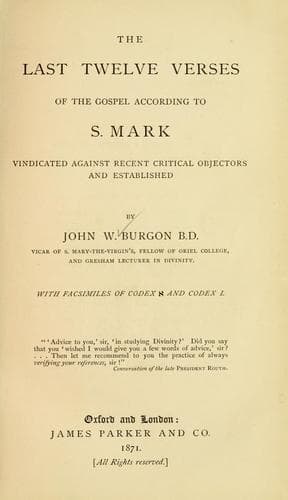
The Last Twelve Verses of the Gospel According to S. MarkBurgon, John William
Religion
The Last Twelve Verses of the Gospel According to S. Mark
Burgon, John William
Bible. Mark XVI, 9-20 -- Criticism, Textual
(ver. 9.) “And it came to pass in those days, that JESUS came from
Nazareth of Galilee, and was baptized of John in Jordan. (10.) And
straightway coming up out of the water, He saw the heavens opened, and the
SPIRIT like a dove descending upon Him: (11.) and there came a voice from
heaven saying, Thou art My beloved SON, in whom I am well pleased. (12.)
And immediately the SPIRIT driveth Him into the wilderness. (13.) And He
was there in the wilderness forty days, tempted of Satan; and was with the
wild beasts; and the Angels ministered unto Him. (14.) Now after that John
was put in prison, JESUS came into Galilee, preaching the gospel of the
kingdom of GOD, (15.) and saying, The time is fulfilled, and the Kingdom
of GOD is at hand: repent ye, and believe the Gospel. (16.) Now, as He
walked by the sea of Galilee, He saw Simon and Andrew his brother casting
a net into the sea: for they were fishers. (17.) And JESUS said unto them,
Come ye after Me, and I will make you to become fishers of men. (18.) And
straightway they forsook their net’s, and followed Him. (19.) And when He
had gone a little farther thence, He saw James the son of Zebedee, and
John his brother, who also were in the ship mending their nets. (20.) And
straightway He called them; and they left their father Zebedee in the ship
with the hired servants, and went after Him.”
4. The candid reader must needs admit that precisely the self-same manner
is recognisable in this first chapter of S. Mark’s Gospel which is
asserted to be peculiar to the last. Note, that from our SAVIOUR’S Baptism
(which occupies the first three verses) the Evangelist passes to His
Temptation, which is dismissed in two. Six months elapse. The commencement
of the Ministry is dismissed in the next two verses. The last five
describe the call of four of the Apostles,—without any distinct allusion
to the miracle which was the occasion of it.... How was it _possible_ that
when incidents considerable as these had to be condensed within the narrow
compass of twelve verses, the same “graphic, detailed description” could
reappear which renders S. Mark’s description of the miracle performed in
the country of the Gadarenes (for example) so very interesting; where a
single incident is spread over twenty verses, although the action did not
perhaps occupy an hour? I rejoice to observe that “the _abrupt
transitions_ of this section” (ver. 1-13) have also been noticed by Dean
Alford: who very justly accounts for the phenomenon by pointing out that
here “Mark appears as _an abridger of previously well-known facts_.”(253)
But then, I want to know what there is in this to induce us to suspect
_the genuineness_ of either the beginning or the end of S. Mark’s Gospel?
Public-domain text, read in full here on John Shaqi.
Reviews
Reviews
No reviews yet
Be the first to share your thoughts on this work.
Elsewhere in the archive
Join the Discussion
Join the discussion
Sign in to leave a comment or review.
Sign InorCreate an account