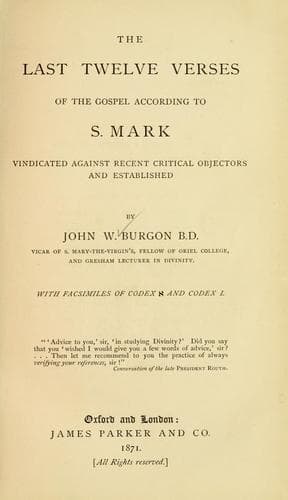
The Last Twelve Verses of the Gospel According to S. MarkBurgon, John William
Religion
The Last Twelve Verses of the Gospel According to S. Mark
Burgon, John William
Bible. Mark XVI, 9-20 -- Criticism, Textual
5. For it is a mistake to speak as if “graphic, detailed description”
_invariably_ characterise the second Gospel. S. Mark is quite as
remarkable for his practice of occasionally exhibiting a considerable
transaction in a highly abridged form. The opening of his Gospel is
singularly concise, and altogether _sudden_. His account of John’s
preaching (i. 1-8) is the shortest of all. Very concise is his account of
our SAVIOUR’S Baptism (ver. 9-11). The brevity of his description of our
LORD’S Temptation is even extraordinary (ver. 12, 13.)—I pass on;
premising that I shall have occasion to remind the reader by-and-by of
certain peculiarities in these same Twelve Verses, which seem to have been
hitherto generally overlooked.
II. Nothing more true, therefore, than Dr. Tregelles’ admission “that
arguments on _style_ are often very fallacious, and that _by themselves_
they prove very little. But” (he proceeds) “when there does exist external
evidence; and when internal proofs as to style, manner, verbal expression,
and connection, are in accordance with such independent grounds of forming
a judgment; then, these internal considerations possess very great
weight.”
I have already shewn that there exists _no_ such external evidence as Dr.
Tregelles supposes. And in the absence of it, I am bold to assert that
since nothing in the “Style” or the “Phraseology” of these verses ever
aroused suspicion in times past, we have rather to be _on our guard_
against suffering our judgment to be warped by arguments drawn from such
precarious considerations now. As for determining from such data the
authorship of an isolated passage; asserting or denying its genuineness
for no other reason but because it contains certain words and expressions
which do or do not occur elsewhere in the Gospel of which it forms
part;—let me again declare plainly that the proceeding is in the highest
degree uncritical. We are not competent judges of what words an Evangelist
was likely on any given occasion to employ. We have no positive knowledge
of the circumstances under which any part of any one of the four Gospels
was written; nor the influences which determined an Evangelist’s choice of
certain expressions in preference to others. We are learners,—we _can_ be
only learners here. But having said all this, I proceed (as already
declared) without reluctance or misgiving to investigate the several
charges which have been brought against this section of the Gospel;
charges derived from its PHRASEOLOGY; and which will be found to be
nothing else but repeated assertions that a certain Word or Phrase,—(there
are about twenty-four such words and phrases in all,(254))—“occurs nowhere
in the Gospel of Mark;” with probably the alarming asseveration that it is
“abhorrent to Mark’s manner.” ... The result of the inquiry which follows
will perhaps be not exactly what is commonly imagined.
Public-domain text, read in full here on John Shaqi.
Reviews
Reviews
No reviews yet
Be the first to share your thoughts on this work.
Elsewhere in the archive
Join the Discussion
Join the discussion
Sign in to leave a comment or review.
Sign InorCreate an account