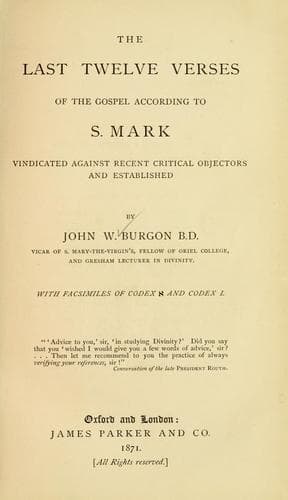
The Last Twelve Verses of the Gospel According to S. MarkBurgon, John William
Religion
The Last Twelve Verses of the Gospel According to S. Mark
Burgon, John William
Bible. Mark XVI, 9-20 -- Criticism, Textual
(2.) Then, further, it is worth observing that while the phrase μετὰ ταῦτα
occurs five times in S. Luke’s Gospel, it is found only twice in the Acts;
while S. Matthew _never employs it at all_. Why, then,—I would
respectfully inquire—_why_ need S. Mark introduce the phrase _more than
once_? Why, especially, is his solitary use of the expression to be
represented as a suspicious circumstance; and even perverted into an
article of indictment against the genuineness of the last twelve verses of
his Gospel? “Would any one argue that S. Luke was not the author of the
Acts, because the author of the Acts has employed this phrase only
twice,—‘often as he _could_ have used it?’ (Meyer’s phrase here.(285))”
(X.) Another objection awaits us,—“Ἓτερος also is unknown to Mark,” says
Dr. Davidson;—which only means that the word occurs in chap. xvi. 12, but
not elsewhere in his Gospel.
It so happens, however, that ἕτερος also occurs once only in the Gospel of
S. John. Does it therefore throw suspicion on S. John xix. 37?
(XI.) The same thing is said of ὕστερον (in ver. 14) viz. that it “occurs
nowhere” in the second Gospel.
But why not state the case thus?—Ὕστερον, a word which is twice employed
by S. Luke, occurs only _once_ in S. Mark and _once_ in S. John.—_That_
would be the true way of stating the facts of the case. But it would be
attended with this inconvenient result,—that it would make it plain that
the word in question has no kind of bearing on the matter in hand.
(XII.) The same thing he says of βλάπτειν (in ver. 18).
But what is the fact? The word occurs _only twice in the Gospels_,—viz. in
S. Mark xvi. 18 and S. Luke iv. 35. It is one of the eighty-four words
which are peculiar to S. Mark and S. Luke. What possible significancy
would Dr. Davidson attach to the circumstance?
(XIII.) Once more.—“πανταχοῦ” (proceeds Dr. Davidson) “is unknown to
Mark;” which (as we begin to be aware) is the learned gentleman’s way of
stating that it is only found in chap. xvi. 20.
Tischendorf, Tregelles, and Alford insist that it _also_ occurs in S. Mark
i. 28. I respectfully differ from them in opinion: but when it has been
pointed out that the word _is only used besides in S. Luke_ ix. 6, what
_can_ be said of such Criticism but that it is simply frivolous?
(XIV. and XV.) Yet again:—συνεργεῖν and βεβαιοῦν are also said by the same
learned Critic to be “unknown to Mark.”
S. Mark certainly uses these two words only once,—viz. in the last verse
of the present Chapter: but what there is suspicious in this circumstance,
I am at a loss even to divine. He _could_ not have used them oftener; and
since one hundred and fifty-six words are peculiar to his Gospel, why
should not συνεργεῖν and βεβαιοῦν be two of them?
(XVI.) “Πᾶσα κτίσις is Pauline,” proceeds Dr. Davidson, (referring to a
famous expression which is found in ver. 15.)
Public-domain text, read in full here on John Shaqi.
Reviews
Reviews
No reviews yet
Be the first to share your thoughts on this work.
Elsewhere in the archive
Join the Discussion
Join the discussion
Sign in to leave a comment or review.
Sign InorCreate an account