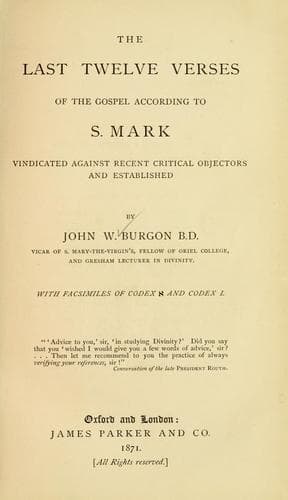
The Last Twelve Verses of the Gospel According to S. MarkBurgon, John William
Religion
The Last Twelve Verses of the Gospel According to S. Mark
Burgon, John William
Bible. Mark XVI, 9-20 -- Criticism, Textual
But really, such a remark is wholly without force, as an argument against
the genuineness of the passage in which the word is found: for,
(1.) Where else in the course of this Gospel _could_ ἀπιστεῖν have
occurred? Now, unless some reason can be shewn why the word _should_, or
at least _might_ have been employed elsewhere, to remark upon its
introduction in this place, _where it __ could scarcely be dispensed
with_, as a ground of suspicion, is simply irrational. It might just as
well be held to be a suspicious circumstance, in respect of verses 3 and
4, that the verb ἀποκυλίζειν occurs there, _and there only_, in this
Gospel. Nothing whatever follows from the circumstance. It is, in fact, a
point scarcely deserving of attention.
(2.) To be sure, if the case of a verb exclusively used by the two
Evangelists, S. Mark and S. Luke, were an unique, or even an exceedingly
rare phenomenon, it might have been held to be a somewhat suspicious
circumstance that the phenomenon presented itself in the present section.
But nothing of the sort is the fact. There are no fewer than forty-five
verbs _exclusively used by S. Mark and S. Luke_. And why should not
ἀπιστεῖν be, (as it is,) one of them?
(3.) Note, next, that this word _is used twice_, and in the course of his
last chapter too, also _by S. Luke_. Nowhere else does it occur in the
Gospels. It is at least as strange that the word ἀπιστεῖν should be found
twice in the last chapter of the Gospel according to S. Luke, as in the
last chapter of the Gospel according to S. Mark. And if no shadow of
suspicion is supposed to result from this circumstance in the case of the
third Evangelist, why should it in the case of the second?
(4.) But, lastly, _the noun_ ἀπιστία (which occurs in S. Mark xvi. 14)
occurs in two other places of the same Gospel. And this word (which S.
Matthew uses twice,) is employed by none of the other Evangelists.—What
need to add another word? Do not many of these supposed suspicious
circumstances,—_this_ one for example,—prove rather, on closer inspection,
to be confirmatory facts?
(IX.) We are next assured that μετὰ ταῦτα (ver. 12) “_is not found in
Mark_, though many opportunities occurred for using it.”
(1.) I suppose that what this learned writer means, is this; that if S.
Mark had coveted an opportunity for introducing the phrase μετὰ ταῦτα
earlier in his Gospel, he might have found one. (More than this cannot be
meant: for _nowhere_ before does S. Mark employ _any other phrase_ to
express “after these things,” or “after this,” or “afterwards.”)
But what is the obvious inference from the facts of the case, as stated by
the learned Critic, except that the blessed Evangelist _must be presumed
to have been unconscious of any desire to introduce the expression under
consideration on any other occasion except the present_?
Public-domain text, read in full here on John Shaqi.
Reviews
Reviews
No reviews yet
Be the first to share your thoughts on this work.
Elsewhere in the archive
Join the Discussion
Join the discussion
Sign in to leave a comment or review.
Sign InorCreate an account