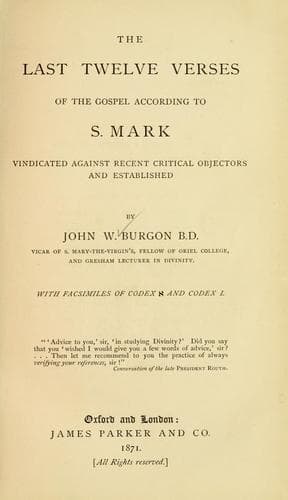
The Last Twelve Verses of the Gospel According to S. MarkBurgon, John William
Religion
The Last Twelve Verses of the Gospel According to S. Mark
Burgon, John William
Bible. Mark XVI, 9-20 -- Criticism, Textual
(XVII.) Next,—ἐν τῷ ὀνόματι μου (ver. 17) is noticed as another suspicious
peculiarity. The phrase is supposed to occur only in this place of S.
Mark’s Gospel; the Evangelist elsewhere employing the preposition
ἐπί:—(viz. in ix. 37: ix. 39: xiii. 6.)
(1.) Now really, if it were so, the reasoning would be nugatory. _S. Luke_
also once, and once only, has ἐν τῷ ὀνόματί σου: his usage elsewhere
being, (like S. Mark’s) to use ἐπί. Nay, in two consecutive verses of ch.
ix, ἐπί τῷ ὀνόματί μου—σου is read: and yet, in the very next chapter, his
Gospel exhibits an unique instance of the usage of ἐν. Was it ever thought
that suspicion is thereby cast on S. Luke x. 17?
(2.) But, in fact, the objection is an oversight of the learned (and
generally accurate) objector. The phrase recurs in S. Mark ix. 38,—as the
text of that place has been revised by Tischendorf, by Tregelles and by
himself. This is therefore a slightly _corroborative_, not a suspicious
circumstance.
(XVIII. and XIX.) We are further assured that παρακολουθεῖν (in ver. 17)
and ἐπακολουθεῖν (in ver. 20) “are both _foreign to the diction of Mark_.”
(1.) But what can the learned author of this statement possibly mean? He
is not speaking of the uncompounded verb ἀκολουθεῖν, of course; for S.
Mark employs it at least twenty times. He cannot be speaking of the
compounded verb; for συνακολουθεῖν occurs in S. Mark v. 37. He cannot mean
that παρακολουθεῖν, because the Evangelist uses it only once, is
suspicious; for that would be to cast a slur on S. Luke i. 3. He cannot
mean generally that verbs compounded with prepositions are “foreign to the
diction of Mark;” for there are no less than _forty-two_ such verbs which
are even _peculiar to S. Mark’s short Gospel_,—against thirty which are
peculiar to S. Matthew, and seventeen which are peculiar to S. John. He
cannot mean that verbs compounded with παρά and ἐπί have a suspicious
look; for at least _thirty-three_ such compounds, (besides the two before
us,) occur in his sixteen chapters.(287) What, then, I must really ask,
can the learned Critic possibly mean?—I respectfully pause for an answer.
(2.) In the meantime, I claim that as far as such evidence goes,—(and it
certainly goes a very little way, yet, _as far as it goes_,)—it is a note
of S. Mark’s authorship, that within the compass of the last twelve verses
of his Gospel these two compounded verbs should be met with.
(XX.) Dr. Davidson points out, as another suspicious circumstance, that
(in ver. 18) the phrase χεῖρας ἐπιτιθέναι ἐπί τινα occurs; “instead of
χεῖρας ἐπιτιθέναι τινι.”
(1.) But on the contrary, the phrase “_is in Mark’s manner_,” says Dean
Alford: the plain fact being that it occurs no less than three times in
his Gospel,—viz. in chap. viii. 25: x. 16: xvi. 18. (The other idiom, he
has four times.(288)) Behold, then, one and the same phrase is appealed to
as a note of genuineness _and_ as an indication of spurious origin. What
_can_ be the value of such Criticism as this?
Public-domain text, read in full here on John Shaqi.
Reviews
Reviews
No reviews yet
Be the first to share your thoughts on this work.
Elsewhere in the archive
Join the Discussion
Join the discussion
Sign in to leave a comment or review.
Sign InorCreate an account