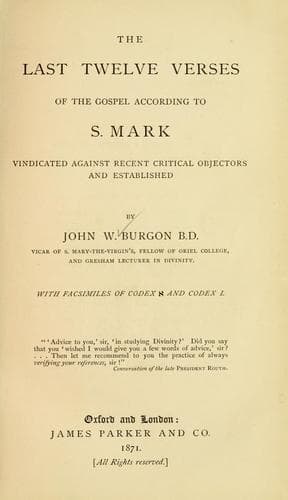
The Last Twelve Verses of the Gospel According to S. MarkBurgon, John William
Religion
The Last Twelve Verses of the Gospel According to S. Mark
Burgon, John William
Bible. Mark XVI, 9-20 -- Criticism, Textual
(2.) Indeed, the phrase before us supplies no unapt illustration of the
precariousness of the style of remark which is just now engaging our
attention. Within the space of three verses, S. Mark has _both_
expressions,—viz. ἐπιθεὶς τὰς χεῖρας αὐτῷ (viii. 23) and also ἐπέθηκε τὰς
χεῖρας ἐπί (ver. 25.) S. Matthew has the latter phrase once; the former,
twice.(289) _Who_ will not admit that all this (so-called) Criticism is
the veriest trifling; and that to pretend to argue about the genuineness
of a passage of Scripture from such evidence as the present is an act of
rashness bordering on folly?... The reader is referred to what was offered
above on Art. VII.
(XXI. and XXII.) Again: the words μὲν οὖν—ὁ Κύριος (ver. 19 and ver. 20)
are also declared to be “_foreign to the diction of Mark_.” I ask leave to
examine these two charges separately.
(1.) μὲν οὖν occurs only once in S. Mark’s Gospel, truly: but then _it
occurs only once in S. Luke_ (iii. 18);—only twice in S. John (xix. 24:
xx. 30):—in S. Matthew, never at all. What imaginable plea can be made out
of such evidence as this, for or against the genuineness of the last
Twelve Verses of S. Mark’s Gospel?—Once more, I pause for an answer.
(2.) As for ὁ Κύριος being “_foreign to the diction of Mark_ in speaking
of the LORD,”—I really do not know what the learned Critic can possibly
mean; except that he finds our LORD _nowhere called_ ὁ Κύριος _by S. Mark,
except in this place._
But then, he is respectfully reminded that neither does he find our LORD
anywhere called by S. Mark “JESUS CHRIST,” except in chap. i. 1. Are we,
therefore, to suspect the beginning of S. Mark’s Gospel as well as the end
of it? By no means, (I shall perhaps be told:) a reason is assignable for
the use of _that_ expression in chap. i. 1. And so, I venture to reply,
there is a fully sufficient reason assignable for the use of _this_
expression in chap. xvi. 19.(290)
(3.) By S. Matthew, by S. Mark, by S. John, our LORD is called Ἰησοῦς
Χριστός,—but _only in the first Chapter_ of their respective Gospels. By
S. Luke nowhere. The appellation may,—or may not,—be thought “foreign to
the diction” of those Evangelists. But surely it constitutes no reason
whatever why we should suspect the genuineness of the beginning of the
first, or the second, or the fourth Gospel.
(4.) S. John _three times in the first verse of his first Chapter_
designates the Eternal SON by the extraordinary title ὁ Λόγος; but
_nowhere else in his Gospel_, (except once in ver. 14,) does that Name
recur. Would it be reasonable to represent _this_ as a suspicious
circumstance? Is not the Divine fitness of that sublime appellation
generally recognised and admitted?(291)—Surely, we come to Scripture to be
learners only: not to teach the blessed Writers how they ought to have
spoken about GOD! When will men learn that “the Scripture-phrase, or
_language of the Holy Ghost_”(292) is as much above them as Heaven is
above Earth?
Public-domain text, read in full here on John Shaqi.
Reviews
Reviews
No reviews yet
Be the first to share your thoughts on this work.
Elsewhere in the archive
Join the Discussion
Join the discussion
Sign in to leave a comment or review.
Sign InorCreate an account