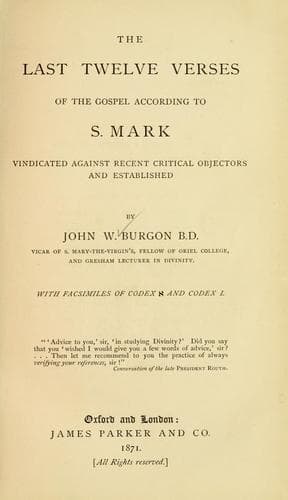
The Last Twelve Verses of the Gospel According to S. MarkBurgon, John William
Religion
The Last Twelve Verses of the Gospel According to S. Mark
Burgon, John William
Bible. Mark XVI, 9-20 -- Criticism, Textual
Thus, (in ver. 1,) we should be informed (i.) that “Mark nowhere uses the
appellation JESUS CHRIST:” and (ii.) that “εὐαγγέλιον Ἰησοῦ Χριστοῦ” is
“_Pauline_”—We should be reminded (iii.) that this Evangelist nowhere
introduces any of the Prophets by name, and that therefore the mention of
“Isaiah”(303) (in ver. 2) is a suspicious circumstance:—(iv.) that a
quotation from the Old Testament is “foreign to his manner,”—(for writers
of this class would not hesitate to assume that S. Mark xv. 28 is no part
of the Gospel;)—and (v.) that the fact that here are quotations from _two_
different prophets, betrays an unskilful hand.—(vi.) Because S. Mark three
times calls Judæa by its usual name (Ιουδαια, viz. in iii. 7: x. 1: xiii.
14), the _unique_ designation, ἡ Ἰουδαία χώρα (in ver. 5) would be
pronounced decisive against “the authorship of Mark.”—(vii.) The same
thing would be said of the _unique_ expression, ἐν Ἰορδάνη ποταμῷ, which
is found in ver. 5,—seeing that this Evangelist three times designates
Jordan simply as Ἰορδάνης (i. 9: iii. 8: x. 1).—(viii.) _That_ entire
expression in ver. 7 (_unique_, it must be confessed, in the Gospel,) οὖ
οὐκ εἰμὶ ἱκανος—ὑποδημάτων αὐτοῦ, would be pronounced “abhorrent to the
style of Mark.”—(ix.) τὸ Πνεῦμα _twice_, (viz. in ver. 10 and ver. 12) we
should be told is never used by the Evangelist absolutely for the HOLY
GHOST: but always τὸ Πνεῦμα τὸ Ἅγιον (as in ch. iii. 29: xii. 36: xiii.
11).—(x.) The same would be said of οἱ Ἱεροσολυμῖται (in ver. 5) for “the
inhabitants of Jerusalem:” we should be assured that S. Mark’s phrase
would rather be οἱ ἀπὸ Ἱεροσολύμων,—as in ch. iii. 8 and 22.—And (xi.) the
expression πιστεύειν ἐν τῷ εὐαγγελίῷ (ver. 15), we should be informed
“cannot be Mark’s;”—who either employs εἰς and the accusative (as in ch.
ix. 92), or else makes the verb take a dative (as in ch. xi. 31: xvi. 13,
14.)—We should also probably be told that the ten following words are all
“unknown to Mark:”—(xii.) τρίχες,—(xiii.) δερματίνη,—(xiv.) ὀσφύς,—(xv.)
ἀκρίδες,—(xvi.) μέλι,—(xvii.) ἄγριος,(six instances in a single verse
(ver. 6): a highly suspicious circumstance!),—(xviii.) κύπτειν,—(xix.)
ἱμάς,—(xx.) ὑποδήματα, (all three instances in ver. 7!)—(xxi.)
εὐδοκεῖν,—(xxii.) καὶ ἐγένετο ... ἦλθεν (ver. 9),—unique in S.
Mark!—(xxiii.) βαπτίζεσθαι εἰς (ver 9), another unique phrase!—(xxiv.) οἱ
οὐρανοί _twice_, (viz. in verses 10, 11) yet elsewhere, when _S. Mark_
speaks of Heaven, (ch. vi. 41: vii. 34: viii. 11: xvi. 19) he always uses
the singular.—Lastly, (xxv.) the same sorry objection which was brought
against the “last twelve verses,” (that πάλιν, a favourite adverb with S.
Mark, is not found there,) is here even more conspicuous.
Public-domain text, read in full here on John Shaqi.
Reviews
Reviews
No reviews yet
Be the first to share your thoughts on this work.
Elsewhere in the archive
Join the Discussion
Join the discussion
Sign in to leave a comment or review.
Sign InorCreate an account