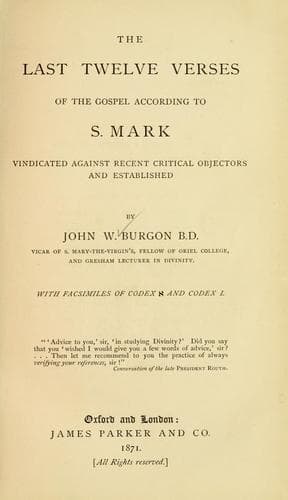
The Last Twelve Verses of the Gospel According to S. MarkBurgon, John William
Religion
The Last Twelve Verses of the Gospel According to S. Mark
Burgon, John William
Bible. Mark XVI, 9-20 -- Criticism, Textual
(iii) Next,—all have been struck, I suppose, with S. Mark’s proneness to
substitute some expression of his own for what he found in the Gospel of
his predecessor S. Matthew: or, when he anticipates something which is
afterwards met with in the Gospel of S. Luke, his aptness to deliver it in
language entirely independent of the later Evangelist. I allude, for
instance; to his substitution of ἐπιβαλὼν ἔκλαιε (xiv. 72) for S.
Matthew’s ἔκλαυσε μικρῶς (xxvi. 75);—and of ὁ τέκτων (vi. 3) for ὁ τοῧ
τέκτονος υιος (S. Matth. xiii. 55).—The “woman of Canaan” in S. Matthew’s
Gospel (γυνὴ Χαναναία, ch. xv. 22), is called “a Greek, a Syrophenician by
nation” in S. Mark’s (Ἑλληνὶς, Συροφοίνισσα τῷ γένει, ch. vii. 26).—At the
Baptism, instead of the “_opened_” heavens of S. Matthew (ἀνεῷχθησαν, ch.
iii. 16) and S. Luke (ἀνεῳχθῆναι, ch. iii. 22), we are presented by S.
Mark with the striking image of the heavens “_cleaving_” or “_being rent
asunder_” (σχιζομένους,(306) ch. i. 10).—What S. Matthew calls τὰ ὅρια
Μαγδαλά (ch. xv. 39), S. Mark designates as τὰ μέρθ Δαλμανουθά (ch. viii.
10.)—In place of S. Matthew’s ζύμη Σαδδουκαίων (ch. xvi. 6), S. Mark has
ζύμη Ἡρώδου (ch. viii. 15.)—In describing the visit to Jericho, for the
δύο τυφλοί of S. Matthew (ch. xx. 29), S. Mark gives υἱὸς Τιμαίου
Βαρτίμαιος ὁ τυφλὸς ... προσαιτῶν (ch. ch. 46.)—For the κλάδους of S.
Matth. xxi. 8, S. Mark (ch. xi. 8) has στοιβάδας; and for the other’s πρὶν
ἀλέκτορα φωνῆσαι (xxvi. 34), he has πρὶν ἢ δίς (xiv. 30.)—It is so
throughout.
Accordingly,—(as we have already more than once had occasion to
remark,)—whereas the rest say only ἡ μία τῶν σαββάτων, S. Mark says πρώτη
σαββάτου (in ver. 9).—Whereas S. Luke (viii. 2) says ἀφ᾽ ἧς δαιμόνια ἑπτὰ
ἐξεληλύθει,—S. Mark records that from her ἐκβεβλήκει ἑπτὰ δαιμόνια.—Very
different is the great ministerial Commission as set down by S. Mark in
ver. 15, 16, from what is found in S. Matthew xxviii. 19, 20.—And whereas
S. Luke says “_their eyes were holden_ that they should not know Him,” S.
Mark says that “He appeared to them _in another form_.” ... Is it credible
that any one fabricating a conclusion to S. Mark’s narrative after S.
Luke’s Gospel had appeared, would have ventured so to paraphrase S. Luke’s
statement? And yet, let the consistent truthfulness of either expression
be carefully noted. _Both_ are historically accurate, but they proceed
from opposite points of view. Viewed on the heavenly side, (God’s side),
the Disciples’ “eyes” (of course) “_were __ holden_:”—viewed on the
earthly side, (Man’s side), the risen SAVIOUR (no doubt) “_appeared in
another form_.”
Public-domain text, read in full here on John Shaqi.
Reviews
Reviews
No reviews yet
Be the first to share your thoughts on this work.
Elsewhere in the archive
Join the Discussion
Join the discussion
Sign in to leave a comment or review.
Sign InorCreate an account