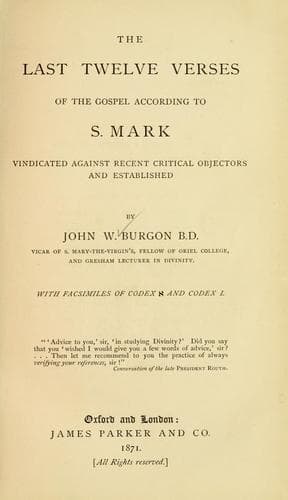
The Last Twelve Verses of the Gospel According to S. MarkBurgon, John William
Religion
The Last Twelve Verses of the Gospel According to S. Mark
Burgon, John William
Bible. Mark XVI, 9-20 -- Criticism, Textual
(iv.) Then further, S. Mark is observed to introduce many expressions into
his Gospel which confirm the prevalent tradition that it was _at Rome_ he
wrote it; and that it was with an immediate view to _Latin_ readers that
it was published. Twelve such expressions were enumerated above (at p.
150-1); and such, it was also there shewn, most unmistakably is the phrase
πρώτη σαββάτου in ver. 9.—It is simply incredible that any one but an
Evangelist writing under the peculiar conditions traditionally assigned to
S. Mark, would have hit upon such an expression as this,—the strict
equivalent, to Latin ears, for ἡ μία σαββάτων, which has occurred just
above, in ver. 2. Now this, it will be remembered, is one of the hacknied
objections to the genuineness of this entire portion of the Gospel;—quite
proof enough, if proof were needed, of the exceeding _improbability_ which
attaches to the phrase, in the judgment of those who have considered this
question the most.
(v.) The last peculiarity of S. Mark to which I propose to invite
attention is supplied by those expressions which connect his Gospel with
S. Peter, and remind us of the constant traditional belief of the ancient
Church that S. Mark was the companion of the chief of the Apostles.
That the second Gospel contains many such hints has often been pointed
out; never more interestingly or more convincingly than by Townson(307) in
a work which deserves to be in the hands of every student of Sacred
Science. Instead of reproducing any of the familiar cases in order to
illustrate my meaning, I will mention one which has perhaps never been
mentioned in this connexion before.
(_a_) Reference is made to our LORD’S sayings in S. Mark vii, and
specially to what is found in ver. 19. _That_ expression, “purging all
meats” (καθαρίζων(308) πάντα τὰ βρώματα), does really seem to be no part
of the Divine discourse; but the Evangelist’s inspired comment on the
SAVIOUR’S words.(309)
Our SAVIOUR (he explains) by that discourse of His—ipso, facto—“_made all
meats clean_.” How doubly striking a statement, when it is remembered that
probably Simon Peter himself was the actual author of it;—the same who, on
the house-top at Joppa, had been shewn in a vision that “GOD _had made
clean_” (ὁ Θεὸς ἐκαθάρισε(310)) _all_ His creatures!
Public-domain text, read in full here on John Shaqi.
Reviews
Reviews
No reviews yet
Be the first to share your thoughts on this work.
Elsewhere in the archive
Join the Discussion
Join the discussion
Sign in to leave a comment or review.
Sign InorCreate an account