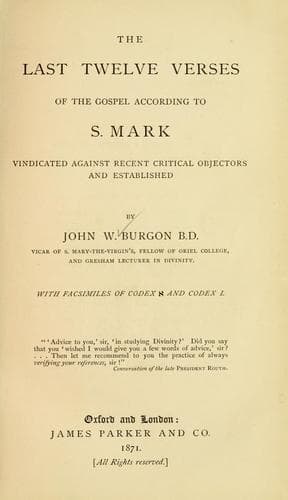
The Last Twelve Verses of the Gospel According to S. MarkBurgon, John William
Religion
The Last Twelve Verses of the Gospel According to S. Mark
Burgon, John William
Bible. Mark XVI, 9-20 -- Criticism, Textual
(_b_) Next, as a matter of fact, we _have_ a spurious Supplement to the
Gospel,—the same which was exhibited above at p. 123-4; and which may here
be with advantage reproduced in its Latin form:—“Omnia autem quaecumque
praecepta erant illis qui cum Petro erant, breviter exposuerunt. Post haec
et ipse Iesus adparuit, et ab oriente usque in occidentem misit per illos
sanctam et incorruptam praedicationem salutis aeternae.
Amen.”(319)—Another apocryphal termination is found in certain copies of
the Thebaic version. It occupies the place of ver. 20, and is as
follows:—“Exeuntes terni in quatuor climata caeli praedicarunt Evangelium
in mundo toto, CHRISTO operante cum iis in verbo confirmationem cum signis
sequentibus eos et miraculis. Atque hoc modo cognitum est regnum Dei in
terra tota et in mundo toto Israelis in testimonium gentium omnium harum
quae exsistunt ab oriente ad occasum.” It will be seen that the Title of
_Dominion_ (ὁ Κύριος—the LORD) is found in neither of these fabricated
passages; but the Names of _Nativity_ and of _Baptism_ (Ἰησοῦς and
Χριστός—JESUS and CHRIST) occur instead.
(ii.) Then further:—It is an extraordinary note of genuineness that such a
vast number of minute but important facts should be found accumulated
within the narrow compass of these twelve verses; and should be met with
_nowhere else_. The writer,—supposing that he had only S. Matthew’s Gospel
before him,—traverses (except in one single instance) _wholly new ground_;
moves forward with unmistakable boldness and a rare sense of security; and
wherever he plants his foot, it is to enrich the soil with fertility and
beauty. But on the supposition that he wrote after S. Luke’s and S. John’s
Gospel had appeared,—the marvel becomes increased an hundred-fold: for how
then does it come to pass that he evidently draws his information from
quite independent sources? is not bound by any of their statements? even
seems _purposely_ to break away from their guidance, and to adventure some
extraordinary statement of his own,—which nevertheless carries the true
Gospel savour with it; and is felt to be authentic from the very
circumstance that no one would have ever dared to invent such a detail and
put it forth on his own responsibility?
(iii.) Second to no indication that this entire section of the Gospel has
a Divine original, I hold to be a famous expression which (like πρώτη
σαββάτου) has occasioned general offence: I mean, the designation of Mary
Magdalene as one “out of whom” the LORD “had cast seven devils;” and
_that_, in immediate connexion with the record of her august privilege of
being the first of the Human Race to behold His risen form. There is such
profound Gospel significancy;—such sublime improbability,—such exquisite
pathos in this record,—that I would defy any fabricator, be he who he
might, to have achieved it. This has been to some extent pointed out
already.(320)
Public-domain text, read in full here on John Shaqi.
Reviews
Reviews
No reviews yet
Be the first to share your thoughts on this work.
Elsewhere in the archive
Join the Discussion
Join the discussion
Sign in to leave a comment or review.
Sign InorCreate an account