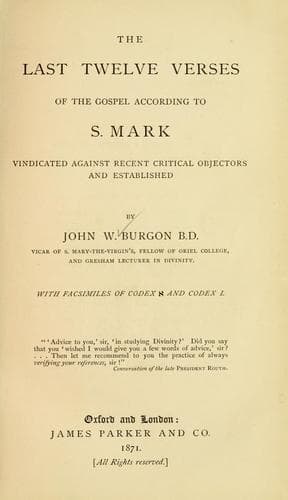
The Last Twelve Verses of the Gospel According to S. MarkBurgon, John William
Religion
The Last Twelve Verses of the Gospel According to S. Mark
Burgon, John William
Bible. Mark XVI, 9-20 -- Criticism, Textual
(iv.) It has also been pointed out, (but the circumstance must be by all
means here insisted upon afresh,) that the designation (found in ver. 10)
of the little company of our LORD’S followers,—“τοῖς μετ᾽ αὐτοῦ
γενομένοις,”—is another rare note of veracious origin. No one but S.
Mark,—or just such an one as he,—would or could have so accurately
designated the little band of Christian men and women who, unconscious of
their bliss, were “mourning and weeping” till after sunrise on the first
Easter Day. The reader is reminded of what has been already offered on
this subject, at p. 155-6.
(v.) I venture further to point out that no writer but S. Mark, (or such
an one as he(321)), would have familiarly designated the Apostolic body as
“αὐτοῖς τοῖς ἔνδεκα,” in ver. 14. The phrase οἱ δώδεκα, he uses in
proportion _far_ oftener than any other two of the Evangelists.(322) And
it is evident that the phrase οἱ ἕνδεκα soon became an equally recognised
designation of the Apostolic body,—“from which Judas by transgression
fell.” Its familiar introduction into this place by the second Evangelist
is exactly what one might have looked for, or at least what one is fully
prepared to meet with, _in him_.
(vi.) I will close this enumeration by calling attention to an unobtrusive
and unobserved verb in the last of these verses which (I venture to say)
it would never have entered into the mind of any ordinary writer to employ
in that particular place. I allude to the familiar word ἐξελθόντες.
The precise meaning of the expression,—depending on the known force of the
preposition with which the verb is compounded,—can scarcely be missed by
any one who, on the one hand, is familiar with the Evangelical method; on
the other, is sufficiently acquainted with the Gospel History. Reference
is certainly made to the final departure of the Apostolic body _out of the
city of Jerusalem_.(323) And tacitly, beyond a question, there is herein
contained a recollection of our SAVIOUR’S command to His Apostles, twice
expressly recorded by S. Luke, “that they should _not depart from
Jerusalem_, but wait for the promise of the FATHER.” “Behold,” (said He,)
“I send the promise of My FATHER upon you: but _tarry ye in the city of
Jerusalem_, until ye be endued with power from on high.”(324)... After
many days “_they went forth_” or “_out_.” S. Mark, (or perhaps it is
rather S. Peter,) expressly says so,—ἐξελθόντες. Aye, and _that_ was a
memorable “outgoing,” truly! What else was its purpose but the
evangelization of the World?
VII. Let this suffice, then, concerning the evidence derived from Internal
considerations. But lest it should hereafter be reckoned as an omission,
and imputed to me as a fault, that I have said nothing about the alleged
_Inconsistency_ of certain statements contained in these “Twelve Verses”
with the larger notices contained in the parallel narratives of S. Luke
and S. John,—I proceed briefly to explain _why_ I am silent on this head.
Public-domain text, read in full here on John Shaqi.
Reviews
Reviews
No reviews yet
Be the first to share your thoughts on this work.
Elsewhere in the archive
Join the Discussion
Join the discussion
Sign in to leave a comment or review.
Sign InorCreate an account