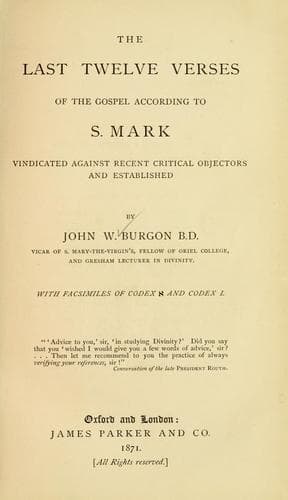
The Last Twelve Verses of the Gospel According to S. MarkBurgon, John William
Religion
The Last Twelve Verses of the Gospel According to S. Mark
Burgon, John William
Bible. Mark XVI, 9-20 -- Criticism, Textual
(10.) Similarly, in S. Matth. xii. 9, xiii. 36, and xiv. 14, Cod. C
inserts ὁ Ἰησοῦς; a reading which on all three occasions is countenanced
by the Syriac and some copies of the old Latin, and on the last of the
three, by Origen also. And yet there can be no doubt that it is only
because _Ecclesiastical lections begin at those places_,(409) that the
Holy Name is introduced there.
(11.) Let me add that the Sacred Name is confessedly an interpolation in
the six places indicated at foot,—its presence being accounted for by the
fact that, in each, an _Ecclesiastical lection begins_.(410) Cod. D in one
of these places, Cod. A in four, is kept in countenance by the old Latin,
the Syriac, the Coptic and other early versions;—convincing indications of
the extent to which the Lectionary practice of the Church had established
itself so early as the second century of our æra.
Cod. D, and copies of the old Latin and Egyptian versions also read τοῦ
Ἰησοῦ, (instead of αὐτοῦ,) in S. Mark xiv. 3; which is only because _a
Church lesson begins there_.
(12.) The same Cod. D is all but unique in leaving out that memorable
verse in S. Luke’s Gospel (xxiv. 12), in which S. Peter’s visit to the
Sepulchre of our risen LORD finds particular mention. It is only because
that verse was claimed both as the _conclusion_ of the ivth and also as
the _beginning_ of the vth Gospel of the Resurrection: so that the
liturgical note ἀρχή stands at the beginning,—τέλος at the end of it.
Accordingly, D is kept in countenance here only by the Jerusalem
Lectionary and some copies of the old Latin. But what is to be thought of
the editorial judgment which (with Tregelles) encloses this verse within
brackets; and (with Tischendorf) _rejects it from the text altogether_?
(13.) Codices B, א, and D are _alone_ among MSS. in omitting the clause
διελθὼν διὰ μέσου αὐτῶν: καὶ παρῆγεν οὔτως, at the end of the 59th verse
of S. John viii. The omission is to be accounted for by the fact that just
_there_ the Church-lesson for Tuesday in the vth week after Easter _came
to an end_.
(14.) Again. It is not at all an unusual thing to find in cursive MSS., at
the end of S. Matth. viii. 13, (with several varieties), the spurious and
tasteless appendix,—καὶ ὑποστρέψας ὁ ἑκατόνταρχος εἰς τὸν οἶκον αὐτοῦ ἐν
αὐτῇ τῇ ὤρᾳ εὗρεν τὸν παῖδα ὑγιαίνοντα: a clause which owes its existence
solely to the practice of ending the lection for the ivth Sunday after
Pentecost in that unauthorized manner.(411) But it is not only in cursive
MSS. that these words are found. _They are met with also in the Codex
Sinaiticus_ (א): a witness at once to the inveteracy of Liturgical usage
in the ivth century of our æra, and to the corruptions which the “Codex
omnium antiquissimus” will no doubt have inherited from a yet older copy
than itself.
Public-domain text, read in full here on John Shaqi.
Reviews
Reviews
No reviews yet
Be the first to share your thoughts on this work.
Elsewhere in the archive
Join the Discussion
Join the discussion
Sign in to leave a comment or review.
Sign InorCreate an account