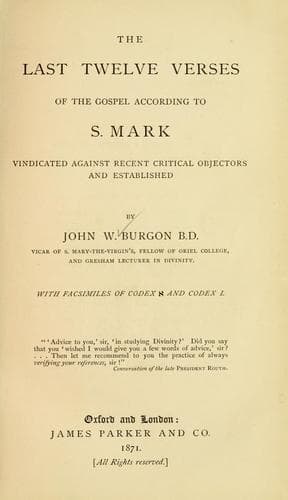
The Last Twelve Verses of the Gospel According to S. MarkBurgon, John William
Religion
The Last Twelve Verses of the Gospel According to S. Mark
Burgon, John William
Bible. Mark XVI, 9-20 -- Criticism, Textual
(5.) The two oldest Codices in existence,—B and א,—stand all but alone in
omitting from S. Luke vi. 1 the unique and indubitably genuine word
δευτεροπρώτῳ; which is also omitted by the Peshito, Italic and Coptic
versions. And yet, when it is observed that an _Ecclesiastical lection
begins here_, and that the Evangelistaria (which _invariably_ leave out
such notes of time) simply drop the word,—only substituting for ἐν σαββάτῳ
the more familiar τοῖς σάββασι,—every one will be ready to admit that if
the omission of this word be not due to the inattention of the copyist,
(which, however, seems to me not at all unlikely,(404)) it is sufficiently
explained by the Lectionary practice of the Church,—which may well date
back even to the immediately post-Apostolic age.
(6.) In S. Luke xvi. 19, Cod. D introduces the Parable of Lazarus with the
formula,—εἶπεν δὲ καὶ ἑτέραν παραβολήν; which is nothing else but a
marginal note which has found its way into the text from the margin; being
_the liturgical introduction of a Church-lesson_(405) which afterwards
began εἶπεν ὁ Κύριος τὴν παραβολὴν ταύτην.(406)
(7.) In like manner, the same Codex makes S. John xiv. begin with _the
liturgical formula_,—(it survives in our Book of Common Prayer(407) to
this very hour!)—καὶ εἶπεν τοῖς μαθήταις αὐτοῦ: in which it is
countenanced by certain MSS. of the Vulgate and of the old Latin Version.
Indeed, it may be stated generally concerning the text of Cod. D, that it
bears marks _throughout_ of the depraving influence of the ancient
Lectionary practice. Instances of this, (in addition to those elsewhere
cited in these pages,) will be discovered in S. Luke iii. 23: iv. 16 (and
xix. 45): v. 1 and 17: vi. 37 (and xviii. 15): vii. 1: x. 1 and 25: xx. 1:
in all but three of which, Cod. D is kept in countenance by the old Latin,
often by the Syriac, and by other versions of the greatest antiquity. But
to proceed.
(8.) Cod. A, (supported by Athanasius, the Vulgate, Gothic, and
Philoxenian versions,) for καί, in S. Luke ix. 57, reads ἐγένετο δὲ,—which
is the reading of the Textus Receptus. Cod. D, (with some copies of the
old Latin,) exhibits καὶ ἐγένετο. All the diversity which is observable in
this place, (and it is considerable,) is owing to the fact that _an
Ecclesiastical lection begins here_.(408) In different Churches, the
formula with which the lection was introduced slightly differed.
(9.) Cod. C is supported by Chrysostom and Jerome, as well as by the
Peshito, Cureton’s and the Philoxenian Syriac, and some MSS. of the old
Latin, in reading ὁ Ἰησοῦς at the beginning of S. Matth. xi. 20. That the
words have no business there, is universally admitted. So also is the
cause of their interpolation generally recognized. _The Ecclesiastical
lection_ for Wednesday in the ivth week after Pentecost _begins at that
place_; and begins with the formula,—ἐν τῷ καίρῳ ἐκεινῳ, ἤρξατο ὁ Ἰησοῦς
ὀνειδίζειν.
Public-domain text, read in full here on John Shaqi.
Reviews
Reviews
No reviews yet
Be the first to share your thoughts on this work.
Elsewhere in the archive
Join the Discussion
Join the discussion
Sign in to leave a comment or review.
Sign InorCreate an account