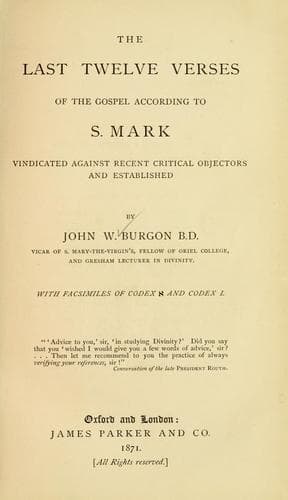
The Last Twelve Verses of the Gospel According to S. MarkBurgon, John William
Religion
The Last Twelve Verses of the Gospel According to S. Mark
Burgon, John William
Bible. Mark XVI, 9-20 -- Criticism, Textual
But the most recent Editors of the text of the New Testament, declining to
entertain so much as the _possibility_ that certain copies of the second
Gospel _had experienced mutilation in very early times_ in respect of
these Twelve concluding Verses, have chosen to occupy themselves rather
with conjectures as to how it may have happened that S. Mark’s Gospel _was
without a conclusion from the very first_. Persuaded that no more probable
account is to be given of the phenomenon than that _the Evangelist himself
put forth a Gospel which_ (for some unexplained reason) _terminated
abruptly at the words_ ἐφοβοῦντο γάρ (chap. xvi. 8),—they have unhappily
seen fit to illustrate the liveliness of this conviction of theirs, by
presenting the world with his Gospel mutilated in this particular way.
Practically, therefore, the question has been reduced to the following
single issue:—Whether of the two suppositions which follow is the more
reasonable:
_First_,—That the Gospel according to S. Mark, as it left the hands of its
inspired Author, _was in this imperfect or unfinished state_; ending
abruptly at (what we call now) the 8th verse of the last chapter:—of which
solemn circumstance, at the end of eighteen centuries, Cod. B and Cod. א
are the alone surviving Manuscript witnesses?... or,
_Secondly_,—That certain copies of S. Mark’s Gospel _having suffered
mutilation_ in respect of their Twelve concluding Verses in the
post-Apostolic age, Cod. B and Cod. א are the only examples of MSS. so
mutilated which are known to exist at the present day?
I. Editors who adopt the former hypothesis, are observed (_a_) to sever
the Verses in question from their context:(462)—(_b_) to introduce after
ver. 8, the subscription “ΚΑΤΑ ΜΑΡΚΟΝ:”(463)—(_c_) to shut up verses 9-20
within brackets.(464) Regarding them as “no integral part of the
Gospel”(465)—“as an authentic anonymous addition to what Mark himself
wrote down,”(466)—a “remarkable Fragment,” “placed as a completion of the
Gospel in very early times;”(467)—they consider themselves at liberty to
go on to suggest that “the Evangelist may have been interrupted in his
work:” at any rate, that “something may have occurred, (as the death of S.
Peter,) to cause him to leave it unfinished.”(468) But “the most probable
supposition” (we are assured) “is, that _the last leaf of the original
Gospel was torn away_.”(469)
We listen with astonishment; contenting ourselves with modestly suggesting
that surely it will be time to conjecture _why_ S. Mark’s Gospel was left
by its Divinely inspired Author in an unfinished state, when the fact has
been established that it probably _was_ so left. In the meantime, we
request to be furnished with some evidence of _that fact_.
Public-domain text, read in full here on John Shaqi.
Reviews
Reviews
No reviews yet
Be the first to share your thoughts on this work.
Elsewhere in the archive
Join the Discussion
Join the discussion
Sign in to leave a comment or review.
Sign InorCreate an account