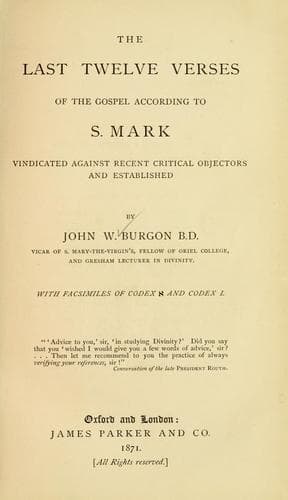
The Last Twelve Verses of the Gospel According to S. MarkBurgon, John William
Religion
The Last Twelve Verses of the Gospel According to S. Mark
Burgon, John William
Bible. Mark XVI, 9-20 -- Criticism, Textual
But not a particle of Evidence is forthcoming. It is not even pretended
that any such evidence exists. Instead, we are magisterially informed by
“the first Biblical Critic in Europe,”—(I desire to speak of him with
gratitude and respect, but S. Mark’s Gospel is a vast deal more precious
to me than Dr. Tischendorf’s reputation,)—that “_a healthy piety reclaims
against the endeavours of those who are for palming off as Mark’s what the
Evangelist is so plainly shewn_ [where?] _to have known nothing at all
about_.”(470) In the meanwhile, it is assumed to be a more reasonable
supposition,—(α) That S. Mark published an imperfect Gospel; and that the
Twelve Verses with which his Gospel concludes were the fabrication of a
subsequent age; than,—(β) That some ancient Scribe having with design or
by accident left out these Twelve concluding Verses, copies of the second
Gospel so mutilated become multiplied, and in the beginning of the ivth
century existed in considerable numbers.
And yet it is notorious that very soon after the Apostolic age, liberties
precisely of this kind were freely taken with the text of the New
Testament. Origen (A.D. 185-254) complains of the licentious tampering
with the Scriptures which prevailed in his day. “Men add to them,” (he
says) “or _leave out_,—as seems good to themselves.”(471) Dionysius of
Corinth, yet earlier, (A.D. 168-176) remarks that it was no wonder his own
writings were added to and _taken from_, seeing that men presumed to
deprave the Word of GOD in the same manner.(472) Irenæus, his
contemporary, (living within seventy years of S. John’s death,) complains
of a corrupted Text.(473) We are able to go back yet half a century, and
the depravations of Holy Writ become avowed and flagrant.(474) A competent
authority has declared it “no less true to fact than paradoxical in sound,
that _the worst corruptions to which the New Testament has been ever
subjected_ originated within a hundred years after it was composed.”(475)
Above all, it is demonstrable that Cod. B and Cod. א abound in
unwarrantable omissions very like the present;(476) omissions which only
do not provoke the same amount of attention because they are of less
moment. One such extraordinary depravation of the Text, _in which they
also stand alone among MSS._ and to which their patrons are observed to
appeal with triumphant complacency, has been already made the subject of
distinct investigation. I am much mistaken if it has not been shewn in my
VIIth chapter, that the omission of the words ἐν Ἐφέσῳ from Ephes. i. 1,
is just as unauthorized,—quite as serious a blemish,—as the suppression of
S. Mark xvi. 9-20.
Now, in the face of facts like these, and in the absence of _any Evidence
whatever_ to prove that S. Mark’s Gospel was imperfect from the first,—I
submit that an hypothesis so violent and improbable, as well as so wholly
uncalled for, is simply undeserving of serious attention. For,
Public-domain text, read in full here on John Shaqi.
Reviews
Reviews
No reviews yet
Be the first to share your thoughts on this work.
Elsewhere in the archive
Join the Discussion
Join the discussion
Sign in to leave a comment or review.
Sign InorCreate an account