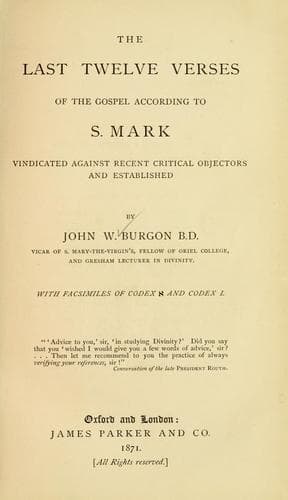
The Last Twelve Verses of the Gospel According to S. MarkBurgon, John William
Religion
The Last Twelve Verses of the Gospel According to S. Mark
Burgon, John William
Bible. Mark XVI, 9-20 -- Criticism, Textual
(iv.) After all that has gone before, our two oldest Codices (Cod. B and
Cod. א) which alone witness to the truth of Eusebius’ testimony as to the
state of certain copies of the Gospels in his own day, need not detain us
long. They are thought to be as old as the ivth century: they are
certainly without the concluding section of S. Mark’s Gospel. But it may
not be forgotten that both Codices alike are disfigured throughout by
errors, interpolations and omissions without number; that their testimony
is continually divergent; and that it often happens that where they both
agree they are both demonstrably in error.(495) Moreover, it is a highly
significant circumstance that the Vatican Codex (B), which is the more
ancient of the two, exhibits _a vacant column_ at the end of S. Mark’s
Gospel,—_the only vacant column in the whole codex_: whereby it is shewn
that the Copyist was aware of the existence of the Twelve concluding
Verses of S. Mark’s Gospel, even though he left them out:(496) while the
original Scribe of the Codex Sinaiticus (א) is declared by Tischendorf to
have actually _omitted the concluding verse of S. John’s Gospel_,—in which
unenviable peculiarity _it stands alone among MSS._(497)
(I.) And thus we are brought back to the point from which we started. We
are reminded that the one thing to be accounted for is _the mutilated
condition of certain copies of S. Mark’s Gospel in the beginning of the
fourth century_; of which, Cod. B and Cod. א are the two solitary
surviving specimens,—Eusebius, the one historical witness. We have to
decide, I mean, between the _evidence_ for this _fact_,—(namely, that
within the first two centuries and a-half of our æra, the Gospel according
to S. Mark _suffered mutilation_;)—and the _reasonableness_ of the other
_opinion_, namely, that S. Mark’s _original autograph_ extended no farther
than ch. xvi. 8. All is reduced to this one issue; and unless any are
prepared to prove that the Twelve familiar Verses (ver. 9 to ver. 20) with
which S. Mark ends his Gospel _cannot_ be his,—(I have proved on the
contrary that he must needs be thought to have written them,(498))—I
submit that it is simply irrational to persist in asseverating that the
reason why those verses are not found in our two Codexes of the ivth
century must be because they did not exist in the original autograph of
the Evangelist. What else is this but to set unsupported _opinion_, or
rather unreasoning _prejudice_, before the _historical evidence_ of a
_fact_? The assumption is not only gratuitous, arbitrary, groundless; but
it is discountenanced by the evidence of MSS., of Versions, of Fathers,
(Versions and Fathers much older than the ivth century:) is rendered in
the highest degree improbable by every internal, every external
consideration: is condemned by _the deliberate judgment of the universal
Church_,—which, in its corporate capacity, for eighteen hundred years, in
all places, has not only solemnly accepted the last Twelve Verses of S.
Public-domain text, read in full here on John Shaqi.
Reviews
Reviews
No reviews yet
Be the first to share your thoughts on this work.
Elsewhere in the archive
Join the Discussion
Join the discussion
Sign in to leave a comment or review.
Sign InorCreate an account