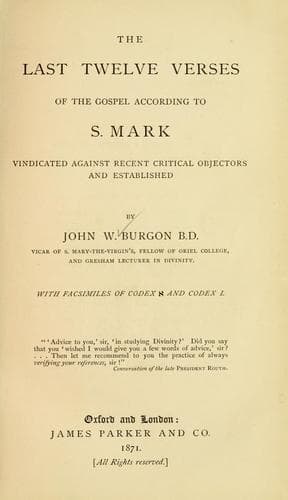
The Last Twelve Verses of the Gospel According to S. MarkBurgon, John William
Religion
The Last Twelve Verses of the Gospel According to S. Mark
Burgon, John William
Bible. Mark XVI, 9-20 -- Criticism, Textual
(III.) Whether,—after the foregoing exposure of a very prevalent and
highly popular, but at the same time most calamitous misapprehension,—it
will not become necessary for Editors of the Text of the New Testament to
reconsider their conclusions in countless other places:—whether they must
not be required to review their method, and to remodel their text
throughout, now that they have been shewn the insecurity of the foundation
on which they have so confidently builded, and been forced to reverse
their verdict in respect of a place of Scripture where at least they
supposed themselves impregnable;—I forbear at this time to inquire.
Enough to have demonstrated, as I claim to have now done, that _not a
particle of doubt_, that _not an atom of suspicion_, attaches to “THE LAST
TWELVE VERSES OF THE GOSPEL ACCORDING TO S. MARK.”
ΤΟ ΤΕΛΟΣ.
APPENDIX (A).
On the importance of attending to Patristic Citations of
Scripture.—The correct Text of S. LUKE ii. 14, established.
(Referred to at p. 22.)
In Chapter III. the importance of attending to Patristic citations of
Scripture has been largely insisted upon. The controverted reading of S.
Luke ii. 14 supplies an apt illustration of the position there maintained,
viz. that this subject has not hitherto engaged nearly as much attention
as it deserves.
I. Instead of ἐν ἀνθρώποις εὐδοκία, (which is the reading of the “Textus
Receptus,”) Lachmann, Tischendorf, Tregelles and Alford present us with ἐν
ἀνθρώποις εὐδοκίας. Their authority for this reading is the consentient
testimony of THE FOUR OLDEST MSS. WHICH CONTAIN S. Luke ii. 14 (viz. B, א,
A, D): THE LATIN VERSIONS generally (“_in hominibus bonae voluntatis_”);
and THE GOTHIC. Against these are to be set, COD. A (in the Hymn at the
end of the Psalms); ALL THE OTHER UNCIALS; together WITH EVERY KNOWN
CURSIVE MS.; and EVERY OTHER ANCIENT VERSION in existence.
So far, the evidence of mere Antiquity may be supposed to preponderate in
favour of εὐδοκίας: though no judicious Critic, it is thought, should
hesitate in deciding in favour of εὐδοκία, even upon the evidence already
adduced. The advocates of the popular Theory ask,—But _why_ should the
four oldest MSS., together with the Latin and the Gothic Versions,
conspire in reading εὐδοκίας, if εὐδοκία be right? That question shall be
resolved by-and-by. Let them in the mean time tell us, if they can,—How is
it credible that, in such a matter as this, _every other MS. and every
other Version in the world_ should read εὐδοκία, if εὐδοκία be wrong? But
the evidence of Antiquity has not yet been nearly cited. I proceed to set
it forth in detail.
It is found then, that whereas εὐδοκίας _is read by none_, εὐδοκία is read
by all the following Fathers:—
(1) ORIGEN, in three places of his writings, [i. 374 D: ii. 714 B: iv. 15
B,—A.D. 240.]
(2) The APOSTOLICAL CONSTITUTIONS, twice, [vii. 47: viii. 12 _ad
fin._,—IIrd cent.]
(3) METHODIUS, [_Galland._ iii. 809 B,—A.D. 290.]
Public-domain text, read in full here on John Shaqi.
Reviews
Reviews
No reviews yet
Be the first to share your thoughts on this work.
Elsewhere in the archive
Join the Discussion
Join the discussion
Sign in to leave a comment or review.
Sign InorCreate an account