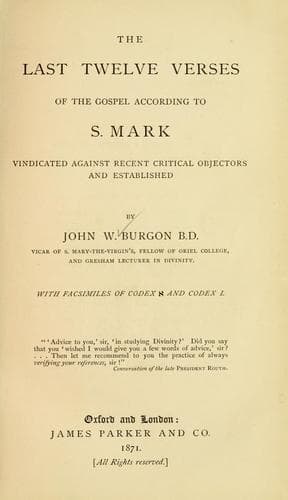
The Last Twelve Verses of the Gospel According to S. MarkBurgon, John William
Religion
The Last Twelve Verses of the Gospel According to S. Mark
Burgon, John William
Bible. Mark XVI, 9-20 -- Criticism, Textual
(4) EUSEBIUS, twice, [_Dem. Ev._ 163 C: 342 B,—A.D. 320.]
(5) APHRAATES THE PERSIAN, (for whose name [_suprà_, pp. 26-7] that of
“Jacobus of Nisibis” has been erroneously substituted), twice, [i. 180 and
385,—A.D. 337.]
(6) TITUS OF BOSTRA, twice, [_in loc._, but especially in S. Luc. xix. 29
(_Cramer_, ii. 141, _line_ 20),—A.D. 350.]
(7) GREGORY OF NAZIANZUS, [i. 845 C,—A.D. 360.]
(8) CYRIL OF JERUSALEM, [A.D. 370], as will be found explained below.
(9) EPIPHANIUS, [i. 154 D,—A.D. 375.]
(10) CHRYSOSTOM, four times, [vii. 311 B: 674 C: viii. 85 C: xi. 374 B
expressly,—A.D. 400.]
(11) CYRIL OF ALEXANDRIA, in three places, [_Comm. on S. Luke_, pp. 12 and
16. Also _Opp._ ii. 593 A: vi. 398 C,—A.D. 420.]
(12) THEODORET, [_in Coloss._ i. 20,-A.D. 430.]
(13) THEODOTUS OF ANCYRA, [_Galland._ x. 446 B,—A.D. 430.]
(14) PROCLUS, Abp. of Constantinople, [_Gall._ x. 629 A,—A.D. 434.]
To which may be added the evidence of
(15) COSMAS INDICOPLEUSTES, four times repeated, [_Coll. Nov. PP._,
(Montfaucon,) ii. 152 A, 160 D, 247 E, 269 C,—A.D. 535.]
(16) EULOGIUS, Abp. of Alexandria, [_Gall._ xii. 308 E,—A.D. 581.]
(17) ANDREAS OF CRETE, twice, [_Gall._ xiii. 100 D, 123 C,—A.D. 635.]
Now, when it is considered that these seventeen Fathers of the Church(500)
all concur in exhibiting the Angelic Hymn _as our own Textus Receptus
exhibits it_,—(viz. ἐν ἀνθρώποις εὐδοκία,)—_who_ does not see that the
four oldest uncial authorities for εὐδοκίας are hopelessly outvoted by
authorities yet older than themselves? Here is, to all intents and
purposes, a record of what was once found in _two Codices of the iii_rd_
century_; in _nine of the iv_th; in _three of the v_th;—added to the
testimony of the two Syriac, the Egyptian, the Ethiopic, and the Armenian
versions. In this instance therefore the evidence of Antiquity is even
overwhelming.
Most decisive of all, perhaps, is the fact this was the form in which _the
Churches of the East_ preserved the Angelic Hymn in their private, as well
as their solemn public Devotions. Take it, from a document of the vth
century:—
ΔΟΞΑ ΕΝ ΥΨΙΣΤΟΙΣ ΘΕΩ
ΚΑΙ ΕΠΙ ΓΗΣ ΕΙΡΗΝΗ
ΕΝ ΑΝΘΡΩΠΟΙΣ ΕΥΔΟΚΙΑ.(501)
But the text of this Hymn, as a Liturgical document, at a yet earlier
period is unequivocally established by the combined testimony of the
Apostolical Constitutions (already quoted,) and of Chrysostom, who says
expressly:—Εὐχαριστοῦντες λέγομεν, Δόξα ἐν ὑψίστοις Θεῷ, καὶ ἐπὶ γῆς
εἰρήνη, ἐν ἀνθρώποις εὐδοκία. [_Opp._ xi. 347 B.] Now this incontestably
proves that _the Church’s established way of reciting the Angelic Hymn in
the iv_th_ century_ was in conformity with the reading of the Textus
Receptus. And this fact infinitely outweighs the evidence of any extant
MSS. which can be named: for it is the consentient evidence of
hundreds,—or rather of thousands of copies of the Gospels of a date
anterior to A.D. 400, which have long since perished.
Public-domain text, read in full here on John Shaqi.
Reviews
Reviews
No reviews yet
Be the first to share your thoughts on this work.
Elsewhere in the archive
Join the Discussion
Join the discussion
Sign in to leave a comment or review.
Sign InorCreate an account