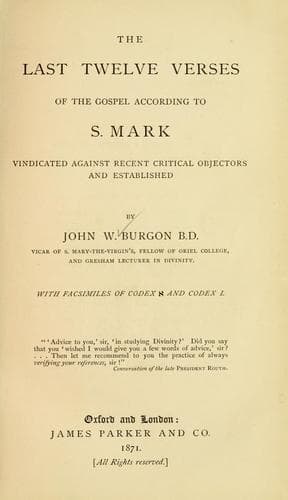
The Last Twelve Verses of the Gospel According to S. MarkBurgon, John William
Religion
The Last Twelve Verses of the Gospel According to S. Mark
Burgon, John William
Bible. Mark XVI, 9-20 -- Criticism, Textual
Whenever the time comes for the Church of England to revise her Authorized
Version (1611), it will become necessary that she should in the first
instance instruct some of the more judicious and learned of her sons
carefully to revise the Greek Text of Stephens (1550). Men require to know
precisely what it is they have to translate before they can pretend to
translate it. As for supposing that Scholars who have been appointed to
revise _a Translation_ are competent at a moment’s notice, as every fresh
difficulty presents itself, to develop the skill requisite for revising
_the original Text_,—it is clearly nothing else but supposing that experts
in one Science can at pleasure shew themselves proficients in another.
But it so happens that, on the present occasion, that _other_ Science is
one of exceeding difficulty. Revisionists _here_ will find it necessary
altogether to disabuse their minds of the _Theory_ of Textual Criticism
which is at present the dominant and the popular one,—and of which I have
made it my business to expose the fallaciousness, in respect of several
crucial texts, in the course of the present work.
I cannot so far forget the unhappy circumstances of the times as to close
this note without the further suggestion, (sure therein of the approval of
our trans-Atlantic brethren,) that, for a Revision of the Authorized
Version to enjoy the confidence of the Nation, and to procure for itself
acceptance at the hands of the Church,—it will be found necessary that the
work should be confided to _Churchmen_. The Church may never abdicate her
function of being “a Witness and a Keeper of Holy Writ.” Neither can she,
without flagrant inconsistency and scandalous consequence, ally herself in
the work of Revision with the Sects. Least of all may she associate with
herself in the sacred undertaking an Unitarian Teacher,—one who avowedly
[see the letter of “One of the Revisionists, G. V. S.,” in the “Times” of
July 11, 1870] denies the eternal GODhead of her LORD. That the individual
alluded to has shewn any peculiar aptitude for the work of a Revisionist;
or that he is a famous Scholar; or that he can boast of acquaintance with
any of the less familiar departments of Sacred Learning; is not even
pretended. (It would matter nothing if the reverse were the case.) What
else, then, is this but to offer a deliberate insult to the Majesty of
Heaven in the Divine Person of Him who is alike the Object of the
Everlasting Gospel, and its Author?
APPENDIX (B).
EUSEBIUS “ad Marinum” concerning the reconcilement of S. Mark xvi.
9 with S. Matthew xxviii. 1.
(Referred to at pp. 46, 47, 54, and 233.)
SUBJOINED is the original text of EUSEBIUS, taken from the “Quæstiones ad
Marinum” published by Card. Mai, in his “Nova Patrum Bibliotheca” (Romae,
1847,) vol. iv. pp. 255-7.
I. Πῶς παρὰ μὲν τῷ Ματθαίῷ ὄψε σαββάτων φαίνεται ἐγεγερμένος ὁ Σωτὴρ, παρὰ
δὲ τῷ Μάρκῳ πρωί τῇ μιᾷ τῶν σαββάτων.
Public-domain text, read in full here on John Shaqi.
Reviews
Reviews
No reviews yet
Be the first to share your thoughts on this work.
Elsewhere in the archive
Join the Discussion
Join the discussion
Sign in to leave a comment or review.
Sign InorCreate an account