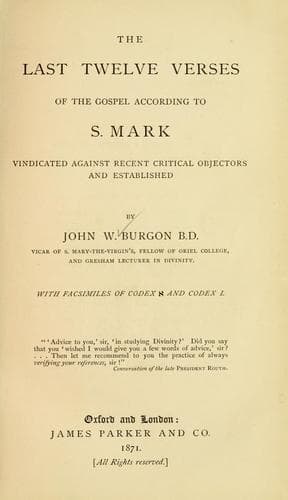
The Last Twelve Verses of the Gospel According to S. MarkBurgon, John William
Religion
The Last Twelve Verses of the Gospel According to S. Mark
Burgon, John William
Bible. Mark XVI, 9-20 -- Criticism, Textual
(2.) The result however—(δόξα ἐν ὑψίστοις Θεῷ καὶ ἐπὶ γῆς εἰρήνη ἀνθρώποις
εὐδοκία)—was obviously an impossible sentence. It could not be allowed to
stand. And yet it was not by any means clear what had happened to it. In
order, as it seems, to _force_ a meaning into the words, some one with the
best intentions will have put the sign of the genitive (Σ) at the end of
εὐδοκία. The copy so depraved was destined to play an important part; for
it became the fontal source of the Latin Version, which exhibits the place
thus:—_Gloria in altissimis __DEO__, et in terra pax hominibus bonae
voluntatis...._ It is evident, by the way, (if the quotation from Irenæus,
given above, is to be depended upon,) that Irenæus must have so read the
place: (viz. εἰρήνη ἀνθρώποις εὐδοκίας.)
(3.) To restore the preposition (ΕΝ) which had been accidentally thrust
out, and to obliterate the sign of the genitive (Σ) which had been without
authority thrust in, was an obvious proceeding. Accordingly, _every Greek
Evangelium extant_ exhibits ἐν ἀνθρώποις: while _all but four_ (B, א, A,
D) read εὐδοκία. In like manner, into some MSS. of the Vulgate (e.g. the
_Cod. Amiatinus_,) the preposition (“in”) has found its way back; but the
genitive (“bonae voluntatis”) has never been rectified in a single copy of
the Latin version.—The Gothic represents a copy which exhibited ἐν
ἀνθρώποις εὐδοκίας.(504)
The consequence is that a well-nigh untranslatable expression retains its
place in the Vulgate to the present hour. Whether (with Origen) we connect
εὐδοκίας with εἰρήνη,—or (with the moderns) we propose to understand “men
of good pleasure,”—the result is still the same. The harmony of the
three-part Anthem which the Angels sang on the night of the Nativity is
hopelessly marred, and an unintelligible discord substituted in its place.
Logic, Divinity, Documents are here all at one. The reading of Stephens is
unquestionably correct. The reading of the latest Editors is as certainly
corrupt. This is a case therefore where the value of Patristic testimony
becomes strikingly apparent. It affords also one more crucial proof of the
essential hollowness of the theory on which it has been recently proposed
by Lachmann, Tischendorf, Tregelles and the rest to reconstruct the text
of the New Testament.
To some, it may perhaps seem unreasonable that so many words should be
devoted to the establishment of the text of a single place of
Scripture,—depending, as that text does, on the insertion or the omission
of a single letter. I am content to ask in reply,—_What_ is important, if
not the utterance of Heaven, when, at the laying of the corner-stone of
the New Creation, “the Morning Stars sang together, and all the Sons of
GOD shouted for joy?”
IV. Only one word in conclusion.
Public-domain text, read in full here on John Shaqi.
Reviews
Reviews
No reviews yet
Be the first to share your thoughts on this work.
Elsewhere in the archive
Join the Discussion
Join the discussion
Sign in to leave a comment or review.
Sign InorCreate an account