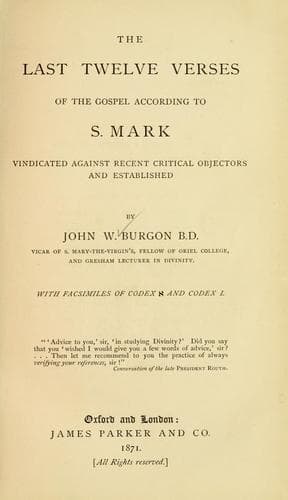
The Last Twelve Verses of the Gospel According to S. MarkBurgon, John William
Religion
The Last Twelve Verses of the Gospel According to S. Mark
Burgon, John William
Bible. Mark XVI, 9-20 -- Criticism, Textual
(ii.) EVAN. 19 ( = Reg. 189: anciently numbered 437 and 1880. Also 134 and
135. At back, 1603.) _A grand folio, well-bound and splendidly written.
Pictures of the Evangelists in such marvellous condition that the very
tools employed by a scribe might be reproduced. The ground gilded.
Headings, &c. and words from Scripture all in gold._
Here also the Commentary on S. Mark’s Gospel is assigned to VICTOR. The
differences between this text and that of Cramer (e.g. at fol. 320-3,
370,) are hopelessly numerous and complicated. There seem to have been
extraordinary liberties taken with the text of this copy throughout.
(iii.) EVAN. 20 (= Reg. 188: anciently numbered 1883.) _A splendid
folio,—the work of several hands and beautifully written._
Victor’s Commentary on S. Mark’s Gospel is generally considered to be
claimed for CYRIL OF ALEXANDRIA by the following words:
ΥΠΟΘΕΣΙΣ ΕΙΣ ΤΟ ΚΑΤΑ ΜΑΡΚΟΝ ΑΓΙΟΝ ΕΥΑΓΓΕΛΙΟΝ
ΕΚ ΤΗΣ ΕΙΣ ΑΥΤΟΝ ΕΡΜΗΝΕΙΑΣ ΤΟΥ ΕΝ ΑΓΙΟΙΣ
ΚΥΡΙΛΛΟΥ ΑΛΕΞΑΝΔΡΕΙΑΣ.
The correspondence between Evan. 20 and Evan. 300 [_infrà_, No. xiv], (=
Reg. 188 and 186), is extraordinary.(529) In S. Mark’s Gospel, (which
alone I examined,) _every page begins with the same syllable, both of Text
and Commentary_: (i.e. Reg. 186, fol. 94 to 197 = Reg. 188, fol. 87 to
140). Not that the number of words and letters in every line corresponds:
but the discrepancy is compensated for by a blank at the end of each
column, and at the foot of each page. Evan. 20 and Evan. 300 seem,
therefore, in some mysterious way referable to a common original. The
sacred Text of these two MSS., originally very dissimilar, has been made
identical throughout; some very ancient (the original?) possessor of Reg.
188 having carefully assimilated the readings of his MS. to those of Reg.
186, the more roughly written copy; which therefore, in the judgment of
the possessor of Reg. 188, exhibits the purer text. But how then does it
happen that in both Codices alike, each of the Gospels (except S.
Matthew’s Gospel in Reg. 188,) ends with the attestation that it has been
collated with approved copies? Are we to suppose that the colophon in
question was added _after_ the one text had been assimilated to the other?
This is a subject which well deserves attention. The reader is reminded
that these two Codices have already come before us at pp. 118-9,—where see
the notes.
I proceed to set down some of the discrepancies between the texts of these
two MSS.: in every one of which, Reg. 188 has been made conformable to
Reg. 186:—
Public-domain text, read in full here on John Shaqi.
Reviews
Reviews
No reviews yet
Be the first to share your thoughts on this work.
Elsewhere in the archive
Join the Discussion
Join the discussion
Sign in to leave a comment or review.
Sign InorCreate an account