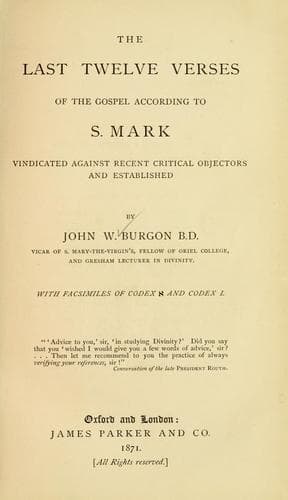
The Last Twelve Verses of the Gospel According to S. MarkBurgon, John William
Religion
The Last Twelve Verses of the Gospel According to S. Mark
Burgon, John William
Bible. Mark XVI, 9-20 -- Criticism, Textual
It will be perceived from this, that EUSEBIUS subdivides these three
portions of the sacred Narrative into ten Sections (“§§;”)—of which three
belong to S. Matthew, viz. §§ 20, 21, 22:—three to S. Mark, viz. §§ 9, 10,
11:—four to S. Luke, viz. §§ 29, 30, 31, 32: which ten Sections, EUSEBIUS
distributed over four of his Canons: referring three of there to his IInd
Canon, (which exhibits what S. Matthew, S. Mark, and S. Luke have in
common); four of them to his VIth Canon, (which shews what S. Matthew and
S. Mark have in common); one, to his IXth, (which contains what is common
to S. Luke and S. John); two, to his Xth, (in which is found what is
peculiar to each Evangelist.)
Now, the design which EUSEBIUS had in breaking up this portion of the
sacred Text, (S. Matth. iv. 18-22, S. Mark i. 16-20, S. Luke v. 1-11,)
after so arbitrary a fashion, into ten portions; divorcing three of those
Sections from S. Matthew’s Gospel, (viz. S. Luke’s §§ 29, 30, 31); and
connecting one of these last three (§ 30) _with two Sections_ (§§ 219,
222) _of S. John;_—is perfectly plain. His object was, (as he himself
explains,) to shew—not only (_a_) what S. Matthew has in common with S.
Mark and S. Luke; but also (_b_) _what S. Luke has in common with S.
John_;—as well as (_c_) what S. Luke has _peculiar to himself_. But, in
the work of AMMONIUS, _as far as we know anything about that work_, all
this would have been simply impossible. (I have already described his
“Diatessaron,” at pp. 126-7.) Intent on exhibiting the Sections of the
other Gospels which correspond with the Sections of _S. Matthew_, AMMONIUS
would not if he could,—(and he could not if he would,)—have dissociated
from its context S. Luke’s account of the first miraculous draught of
fishes in the beginning of our LORD’S Ministry, for the purpose of
establishing its resemblance to S. John’s account of the _second_
miraculous draught of fishes which took place after the Resurrection, and
is only found in S. John’s Gospel. These Sections therefore are
“EUSEBIAN,” not _Ammonian_. They are _necessary_, according to the scheme
of EUSEBIUS. They are not only unnecessary and even meaningless, but
actually impossible, in the AMMONIAN scheme.
Public-domain text, read in full here on John Shaqi.
Reviews
Reviews
No reviews yet
Be the first to share your thoughts on this work.
Elsewhere in the archive
Join the Discussion
Join the discussion
Sign in to leave a comment or review.
Sign InorCreate an account