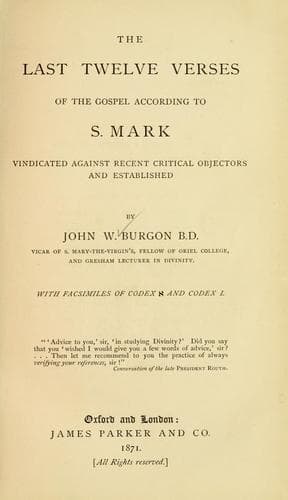
The Last Twelve Verses of the Gospel According to S. MarkBurgon, John William
Religion
The Last Twelve Verses of the Gospel According to S. Mark
Burgon, John William
Bible. Mark XVI, 9-20 -- Criticism, Textual
2. Let me call attention to another, and, as I think, a more convincing
instance. I am content in fact to narrow the whole question to the
following single issue:—Let me be shewn how it is rationally conceivable
that AMMONIUS can have split up S. John xxi. 12, 13, into _three distinct
Sections_; and S. John xxi. 15, 16, 17, into _six?_ and yet, after so many
injudicious disintegrations of the sacred Text, how it is credible that he
can have made but _one_ Section of S. John xxi. 18 to 25,—which
nevertheless, from its very varied contents, confessedly requires even
_repeated_ subdivision?... Why EUSEBIUS did all this, is abundantly plain.
His peculiar plan constrained him to refer the _former_ half of ver.
12,—the _latter_ half of verses 15, 16, 17—to his IXth Canon, where S.
Luke and S. John are brought together; (ἐν ᾧ οἱ δύο τὰ παρακλήσια
εἰρήκασι):—and to consign the _latter_ half of ver. 12,—the _former_ half
of verses 15, 16, 17,—together with the whole of the _last eight verses_
of S. John’s Gospel, to his Xth (or last) Canon, where what is peculiar to
each of the four Evangelists is set down, (ἐν ᾧ περὶ τίνων ἕκαστος αὐτῶν
ἰδίως ἀνέγραψεν.) But AMMONIUS, because he confessedly _recognised no such
Canons_, was under no such constraint. He had in fact _no such
opportunity_. He therefore simply _cannot_ have adopted the same
extraordinary sectional subdivision.
3. To state the matter somewhat differently, and perhaps to exhibit the
argument in a more convincing form:—The Canons of EUSEBIUS, and the
so-called “AMMONIAN _SECTIONS_,”—(by which, confessedly, nothing else
whatever is _meant_ but the Sections of EUSEBIUS,)—are discovered mutually
to imply one another. Those Canons are without meaning or use apart from
the Sections,—for the sake of which they were clearly invented. Those
Sections, whatever convenience they may possess apart from the Canons,
nevertheless are discovered to presuppose the Canons throughout: to be
manifestly subsequent to them in order of time: to depend upon them for
their very existence: in some places to be even unaccountable in the
eccentricity of their arrangement, except when explained by the
requirements of the EUSEBIAN Canons. I say—_That_ particular sectional
subdivision, in other words, to which the epithet “AMMONIAN” is popularly
applied,—(applied however without authority, and in fact by the merest
license,)—proves on careful inspection to have been only capable of being
devised by one _who was already in possession of the Canons of _EUSEBIUS.
In plain terms, they are demonstrably _the work of _EUSEBIUS_
himself_,—who expressly claims _The Canons_ for his own (κανόνας δέκα τὸν
ἀριθμὸν διεχάραξά σοι), and leaves it to be inferred that he is the Author
of the Sections also. Wetstein (_Proleg._ p. 70,) and Bishop Lloyd (in the
“Monitum” prefixed to his ed. of the Greek Test. p. x,) so understand the
matter; and Mr. Scrivener (_Introduction_, p. 51) evidently inclines to
the same opinion.
Public-domain text, read in full here on John Shaqi.
Reviews
Reviews
No reviews yet
Be the first to share your thoughts on this work.
Elsewhere in the archive
Join the Discussion
Join the discussion
Sign in to leave a comment or review.
Sign InorCreate an account