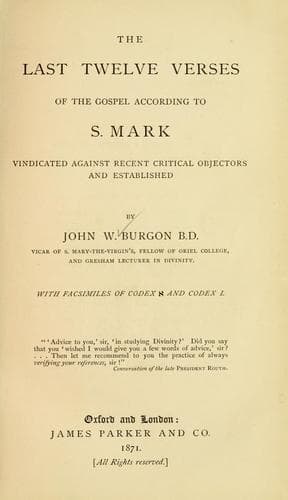
The Last Twelve Verses of the Gospel According to S. MarkBurgon, John William
Religion
The Last Twelve Verses of the Gospel According to S. Mark
Burgon, John William
Bible. Mark XVI, 9-20 -- Criticism, Textual
II. I desire, in the next place, to point out that a careful inspection of
the Eusebian “Sections,” (for Eusebius himself calls them περικοπαί, not
κεφάλαια,) leads inevitably to the inference that they are only rightly
understood when regarded in the light of “MARGINAL REFERENCES.” This has
been hitherto overlooked. Bp. Lloyd, in the interesting “Monitum” already
quoted, remarks of the Eusebian Canons,—“quorum haec est utilitas, ut
eorum scilicet ope quivis, nullo labore, Harmoniam sibi quatuor
Evangeliorum possit conficere.” The learned Prelate can never have made
the attempt in this way “Harmoniam sibi conficere,” or he would not have
so written. He evidently did not advert to the fact that Eusebius refers
his readers (in his IIIrd Canon) from S. John’s account of the _Healing of
the Nobleman’s son_ to the account given by S. Matthew and S. Luke of the
_Healing of the Centurion’s servant_. It is perfectly plain in fact that
to enable a reader “to construct for himself _a Harmony of the Gospels_,”
was no part of Eusebius’ intention; and quite certain that any one who
shall ever attempt to avail himself of the system of Sections and Canons
before us with that object, will speedily find himself landed in hopeless
confusion.(543)
But in fact there is no danger of his making much progress in his task.
His first discovery would probably be that S. John’s weighty doctrinal
statements concerning our LORD’S _Eternal _GOD_head_ in chap. i. 1-5: 9,
10: 14, are represented as parallel with the _Human Genealogy_ of our
SAVIOUR as recorded by S. Matthew i. 1-16, and by S. Luke iii. 23-38:—the
next, that the first half of the Visit of the Magi (S. Matthew ii. 1-6) is
exhibited as corresponding with S. John vii. 41, 42.—Two such facts ought
to open the eyes of a reader of ordinary acuteness quite wide to the true
nature of the Canons of Eusebius. They are _Tables of Reference only_.
Eusebius has in fact himself explained his object in constructing them;
which (he says) was twofold: (1st) To enable a reader to see at a glance,
“_which_ of the Evangelists have said _things of the same kind_,” (τίνες
τὰ παραπλήσια εἰρήκαςι: the phrase occurs _four times_ in the course of
his short Epistle): and (2ndly), To enable him to find out _where_ they
have severally done so: (τοὺς οἰκείους ἑκάστου εὐαγγελιστοῦ τόπους, ἐν οἶς
κατὰ τῶν αὐτῶν ἠνέχθησαν εἰπεῖν; Eusebius uses the phrase _twice_.) But
this, (as all are aware) is precisely the office of (what are called)
“Marginal References.” Accordingly,
(_a._) Whether referring _from_ S. Matth. x. 40 (§ 98); S. Mark ix. 37 (§
96); or S. Luke x. 16 (§ 116);—we find ourselves referred _to_ the
following _six_ places of S. John,—v. 23: xii. 44, 45: xiii. 20: xiv. 21:
xiv. 24, 25: xv. 23(544) (= §§ 40, 111, 120, 129, 131, 144.) Again,
Public-domain text, read in full here on John Shaqi.
Reviews
Reviews
No reviews yet
Be the first to share your thoughts on this work.
Elsewhere in the archive
Join the Discussion
Join the discussion
Sign in to leave a comment or review.
Sign InorCreate an account