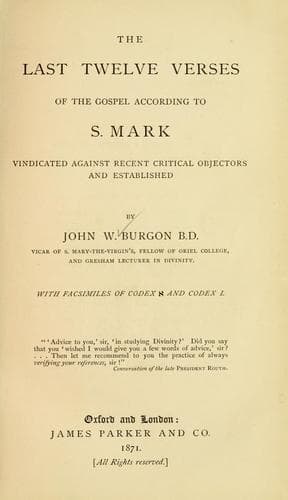
The Last Twelve Verses of the Gospel According to S. MarkBurgon, John William
Religion
The Last Twelve Verses of the Gospel According to S. Mark
Burgon, John William
Bible. Mark XVI, 9-20 -- Criticism, Textual
2. Further, it is obvious that a really ancient Codex of the Gospels must
needs supply more valuable critical help in establishing the precise Text
of Scripture than can possibly be rendered by any Translation, however
faithful: while Patristic citations are on the whole a less decisive
authority, even than Versions. The reasons are chiefly these:—(_a._)
Fathers often quote Scripture loosely, if not licentiously; and sometimes
_allude_ only when they seem to _quote_. (_b._) They appear to have too
often depended on their memory, and sometimes are demonstrably loose and
inaccurate in their citations; the same Father being observed to quote the
same place in different ways. (_c._) Copyists and Editors may not be
altogether depended upon for the exact form of such supposed quotations.
Thus the evidence of Fathers must always be to some extent precarious.
3. On the other hand, it cannot be too plainly pointed out that
when,—instead of certifying ourselves of the _actual words employed_ by an
Evangelist, their precise _form_ and exact _sequence_,—our object is only
to ascertain whether a considerable passage of Scripture is genuine or
not; is to be rejected or retained; was known or was not known in the
earliest ages of the Church; then, instead of supplying the least
important evidence, Fathers become by far the most valuable witnesses of
all. This entire subject may be conveniently illustrated by an appeal to
the problem before us.
4. Of course, if we possessed copies of the Gospels coeval with their
authors, nothing could compete with such evidence. But then unhappily
nothing of the kind is the case. The facts admit of being stated within
the compass of a few lines. We have one Codex (the Vatican, B) which is
thought to belong to the first half of the ivth century; and another, the
newly discovered Codex Sinaiticus, (at St. Petersburg, א) which is
certainly not quite so old,—perhaps by 50 years. Next come two famous
codices; the Alexandrine (in the British Museum, A) and the Codex Ephraemi
(in the Paris Library, C), which are probably from 50 to 100 years more
recent still. The Codex Bezae (at Cambridge, D) is considered by competent
judges to be the depository of a recension of the text as ancient as any
of the others. Notwithstanding its strangely depraved condition
therefore,—the many “monstra potius quam variae lectiones” which it
contains,—it may be reckoned with the preceding four, though it must be 50
or 100 years later than the latest of them. After this, we drop down, (as
far as S. Mark is concerned,) to 2 uncial MSS. of the viiith century,—7 of
the ixth,—4 of the ixth or xth,(29) while cursives of the xith and xiith
centuries are very numerous indeed,—the copies increasing in number in a
rapid ratio as we descend the stream of Time. Our primitive manuscript
witnesses, therefore, are but _five_ in number at the utmost. And of these
it has never been pretended that the oldest is to be referred to an
Public-domain text, read in full here on John Shaqi.
Reviews
Reviews
No reviews yet
Be the first to share your thoughts on this work.
Join the Discussion
Join the discussion
Sign in to leave a comment or review.
Sign InorCreate an account