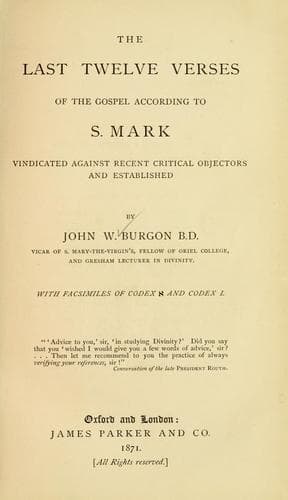
The Last Twelve Verses of the Gospel According to S. MarkBurgon, John William
Religion
The Last Twelve Verses of the Gospel According to S. Mark
Burgon, John William
Bible. Mark XVI, 9-20 -- Criticism, Textual
ver. 6, ... § 232, in 3 Codices, (viz. A, U, 286)
ver. 8, ... § 233, in 34 Codices, (including L, S)(566)
ver. 9, (?) § 234, in 41 Codices, (including Γ, Δ, Π)(567)
ver. 10, (?) § 235, in 4 Codices, (viz. 67, 282, 331, 406)
ver. 12, (?) § 236, in 7 Codices, (the number assigned by Suidas)(568)
ver. 14, (?) § 237, in 12 Codices, (including Λ)(569)
ver. 15, ... § 238, in 3 Codices, (viz. Add. 19,387: 27,861, Ti)
ver. 17, ... § 239, in 1 Codex, (viz. G)
ver. 19, ... § 240, in 10 Codices, (including H, M, and the Codices
from which the Hharklensian Revision, A.D. 616, was made)(570)
ver. 20, ... § 241, in 36 Codices, (including C, E, K, V)(571)
Thus, it is found that 114 Codices sectionize the last Twelve Verses,
against 37 which close the account at ver. 8, or sooner. I infer—(_a_)
That the reckoning which would limit the sections to precisely 233, is
altogether precarious; and—(_b_) That the sum of the Sections assigned to
S. Mark’s Gospel by Suidas and by Stephens (viz. 236) is arbitrary.
VII. To some, it may not be unacceptable, in conclusion, to be presented
with the very words in which Eusebius explains how he would have his
Sections and Canons used. His language requires attention. He says:—
Εἰ οὖν ἀναπτύξας ἕν τι τῶν τεσσάρων εὐαγγελίων ὁποιονδήποτε, βουληθείης
ἐπιστῆναι τινι ᾧ βούλει κεφαλαίῳ, καὶ γνῶναι τίνες τὰ παραπλήσια εἰρήκασι,
καὶ τοὺς οἰκείους ἐν ἑκάστῳ τόπους εὑρεῖν ἐν οἶς κατὰ τῶν αὐτῶν ἠνέχθησαν,
ἧς ἐπέχεις περικοπῆς ἀναλαβὼν τὸν προκείμενον ἀριθμὸν, ἐπιζητήσας τὲ αὐτὸν
ἔνδον ἐν τῷ κανόνι ὄν ἡ διὰ τοῦ κινναβάρεως ὑποσημείωσις ὑποβέβληκεν, εἴσῃ
μὲν εὐθὺς ἐκ τῶν ἐπὶ μετώπου τοῦ κανόνος προγραφῶν, ὁπόσοι καὶ τίνες τὰ
παραπλήσια εἰρήκασιν; ἐπιστήσας δὲ καὶ τοῖς τῶν λοιπῶν εὐαγγελίων ἀριθμοῖς
τοῖς ἐν τῷ κανόνι ᾧ ἐπέχεις ἀριθμῷ παρακειμένοις, ἐπιζητήσας τὲ αὐτοὺς
ἔνδον ἐν τοῖς οἰκείοις ἑκάστου εὐαγγελίου τόποις, τὰ παραπλήσια λέγοντας
εὑρήσεις.
Jerome,—who is observed sometimes to exhibit the sense of his author very
loosely,—renders this as follows:—
“Cum igitur aperto Codice, verbi gratia, illud sive illud Capitulum scire
volueris cujus Canonis sit, statim ex subjecto numero doceberis; et
recurrens ad principia, in quibus Canonum est distincta congeries,
eodemque statim Canone ex titulo frontis invento, illum quem quærebas
numerum, ejusdem Evangelistæ, qui et ipse ex inscriptione signatur,
invenies; atque e vicino ceterorum tramitibus inspectis, quos numeros e
regione habeant, annotabis. Et cum scieris, recurres ad volumina
singulorum, et sine mora repertis numeris quos ante signaveras, reperies
et loca in quibus vel eadem, vel vicina dixerunt.”
This may be a very masterly way of explaining the use of the Eusebian
Canons. But the points of the original are missed. What Eusebius actually
says is this:—
Public-domain text, read in full here on John Shaqi.
Reviews
Reviews
No reviews yet
Be the first to share your thoughts on this work.
Elsewhere in the archive
Join the Discussion
Join the discussion
Sign in to leave a comment or review.
Sign InorCreate an account