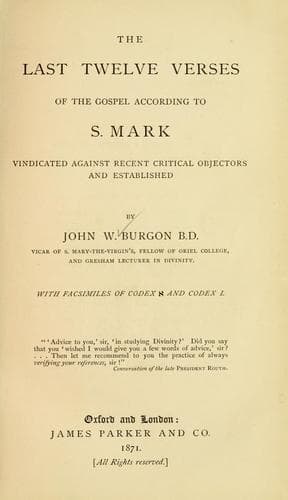
The Last Twelve Verses of the Gospel According to S. MarkBurgon, John William
Religion
The Last Twelve Verses of the Gospel According to S. Mark
Burgon, John William
Bible. Mark XVI, 9-20 -- Criticism, Textual
This writer is perfectly correct in his statement. In Chrysostom’s 88th
Homily on S. Matthew’s Gospel, (_Opp._ vii, 825 C: [vol. ii, p. 526, _ed._
Field.]) is read as follows:—Ἐνόμισαν Ἠλίαν εἶναι, φησὶ, τὸν καλούμενον,
καὶ εὐθέως ἐπότισαν αὐτὸν ὄξος: (which is clearly meant to be a summary of
the contents _of ver._ 48: then follows) ἕτερος δὲ προσελθών λόγχῃ αὐτοῦ
τῆν πλευρὰν ἔνυξε. (Chrysostom quotes no further, but proceeds,—Τί γένοιτ
ἄν τούτων παρανομώτερον, τί δὲ θηριωδέστερον, κ.τ.λ.)
I find it impossible on a review of the evidence to adhere to the opinion
I once held, and have partially expressed above, (viz. at p. 202,) that
the Lectionary-practice of the Eastern Church was the occasion of this
corrupt reading in our two oldest uncials. A corrupt reading it undeniably
is; and the discredit of exhibiting it, Codd. B, א, (not to say Codd. C,
L, U, Γ,) must continue to sustain. That Chrysostom and Cyril also
employed Codices disfigured by this self-same blemish, is certain. It is
an interesting and suggestive circumstance. Nor is this all. Severus(574)
relates that between A.D. 496 and 511, being at Constantinople, he had
known this very reading strenuously discussed: whereupon had been produced
a splendid copy of S. Matthew’s Gospel, traditionally said to have been
found with the body of the Apostle Barnabas in the Island of Cyprus in the
time of the Emperor Zeno (A.D. 474-491); and preserved in the palace with
superstitious veneration in consequence. It contained no record of the
piercing of the SAVIOUR’S side: nor (adds Severus) does any ancient
Interpreter mention the transaction in that place,—except Chrysostom and
_Cyril of Alexandria_; into whose Commentaries it has found its way.—Thus,
to Codices B, א, C and the copy familiarly employed by Chrysostom, has to
be added the copy which Cyril of Alexandria(575) employed; as well as
evidently sundry other Codices extant at Constantinople about A.D. 500.
That the corruption of the text of S. Matthew’s Gospel under review is
ancient therefore, and was once very widely spread, is certain. The
question remains,—and this is the only point to be determined,—How did it
_originate_?
Now it must be candidly admitted, that if the strange method of the
Lectionaries already explained, (viz. of interposing seven verses of S.
John’s xixth chapter [ver. 31-7] between the 54th and 55th verses of S.
Matth. xxvii,) really were the occasion of this interpolation of S. John
xix. 34 after S. Matth. xxvii. 48 or 49,—two points would seem to call for
explanation which at present remain unexplained: First, (1) Why does _only
that one verse_ find place in the interpolated copies? And next, (2) How
does it come to pass that _that_ one verse is exhibited in so very
depraved and so peculiar a form?
Public-domain text, read in full here on John Shaqi.
Reviews
Reviews
No reviews yet
Be the first to share your thoughts on this work.
Elsewhere in the archive
Join the Discussion
Join the discussion
Sign in to leave a comment or review.
Sign InorCreate an account