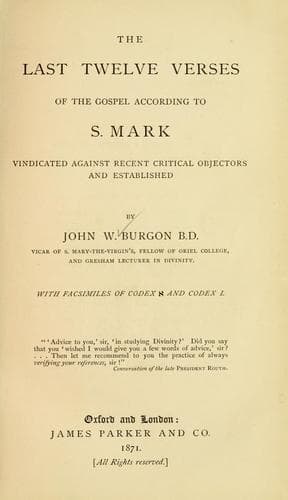
The Last Twelve Verses of the Gospel According to S. MarkBurgon, John William
Religion
The Last Twelve Verses of the Gospel According to S. Mark
Burgon, John William
Bible. Mark XVI, 9-20 -- Criticism, Textual
For, to say nothing of the inverted order of the two principal words,
(which is clearly due to 1 S. John v. 6,) let it be carefully noted that
the substitution of ἄλλος δὲ λαβών λόγχην, for ἀλλ᾽ εἶς τῶν στρατιωτῶν
λόγχῃ of the Evangelist, is a tell-tale circumstance. The turn thus
licentiously given to the narrative clearly proceeded from some one who
was bent on weaving incidents related by different writers into a
connected narrative, and who was sometimes constrained to take liberties
with his Text in consequence. (Thus, S. Matthew having supplied the fact
that “ONE OF THEM ran, and _took a sponge_, and filled it with vinegar,
and put it on a reed, and gave Him to drink,” S. John is made to say, “AND
ANOTHER—_took a spear_.”) Now, this is exactly what Tatian is related by
Eusebius to have done: viz. “after some fashion of his own, to have
composed out of the four Gospels one connected narrative.”(576)
When therefore, (as in the present Scholion,) an ancient Critic who
appears to have been familiarly acquainted with the lost “Diatessaron” of
Tatian, comes before us with the express declaration that in that famous
monument of the primitive age (A.D. 173), S. John’s record of the piercing
of our SAVIOUR’S side was thrust into S. Matthew’s History of the Passion
in this precise way and in these very terms,—(for, “Note,” he says, “That
into the Evangelical History of Diodorus, of Tatian, and of divers other
holy Fathers, is introduced [here] the following addition: ‘And another
took a spear and pierced His side, and there came out Water and Blood.’
This, Chrysostom also says”),—it is even unreasonable to seek for any
other explanation of the vitiated text of our two oldest Codices. Not only
is the testimony to the critical fact abundantly sufficient, but the
proposed solution of the difficulty, in itself the reverse of improbable,
is in the highest degree suggestive as well as important. For,—May we not
venture to opine that the same καθ᾽ ἱστορίαν εὐαγγέλιον,—as this Writer
aptly designates Tatian’s work,—is responsible for not a few of the
_monstra potius quam variae lectiones_(577) which are occasionally met
with in the earliest MSS. of all? And,—Am I not right in suggesting that
the circumstance before us is _the only thing we know for certain_ about
the text of Tatian’s (miscalled) “Harmony?”
Public-domain text, read in full here on John Shaqi.
Reviews
Reviews
No reviews yet
Be the first to share your thoughts on this work.
Elsewhere in the archive
Join the Discussion
Join the discussion
Sign in to leave a comment or review.
Sign InorCreate an account