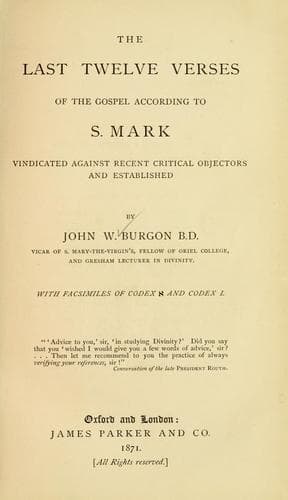
The Last Twelve Verses of the Gospel According to S. MarkBurgon, John William
Religion
The Last Twelve Verses of the Gospel According to S. Mark
Burgon, John William
Bible. Mark XVI, 9-20 -- Criticism, Textual
(9.) Least of all am I concerned to say anything more about the longer
Scholion; seeing that S. Mark is not so much as mentioned in it. But I may
as well point out that, _as it stands_, Eusebius cannot have been its
Author: the proof being, that whereas the Scholion in question is a note
on S. John xxi. 12, (as Matthaei is careful to inform us,)—its opening
sentence is derived _from Chrysostom’s Commentary on that same verse_ in
his 87th Homily on S. John.(586)
(10.) And thus, one by one, every imposing statement of the Critics is
observed hopelessly to collapse as soon as it is questioned, and to vanish
into thin air.
So much has been offered, only because of the deliberate pledge I gave in
p. 51.—Never again, I undertake to say, will the “Scholion of Eusebius”
which has cost my friend at Moscow, his Archimandrites, and me, so much
trouble, be introduced into any discussion of the genuineness of the last
Twelve Verses of the Gospel according to S. Mark. As the oversight of one
(C. F. Matthaei) who was singularly accurate, and towards whom we must all
feel as towards a Benefactor, let it be freely forgiven as well as loyally
forgotten!
L’ENVOY
As one, escaped the bustling trafficking town,
Worn out and weary, climbs his favourite hill
And thinks it Heaven to see the calm green fields
Mapped out in beautiful sunlight at his feet:
Or walks enraptured where the fitful south
Comes past the beans in blossom; and no sight
Or scent or sound but fills his soul with glee:—
So I,—rejoicing once again to stand
Where Siloa’s brook flows softly, and the meads
Are all enamell’d o’er with deathless flowers,
And Angel voices fill the dewy air.
Strife is so hateful to me! most of all
A strife of words about the things of GOD.
Better by far the peasant’s uncouth speech
Meant for the heart’s confession of its hope.
Sweeter by far in village-school the words
But half remembered from the Book of Life,
Or scarce articulate lispings of the Creed.
And yet, three times that miracle of Spring
The grand old tree that darkens Exeter wall
Hath decked itself with blossoms as with stars,
Since I, like one that striveth unto death,
Find myself early and late and oft all day
Engaged in eager conflict for GOD’S Truth;
GOD’S Truth, to be maintained against Man’s lie.
And lo, my brook which widened out long since
Into a river, threatens now at length
To burst its channel and become a sea.
Public-domain text, read in full here on John Shaqi.
Reviews
Reviews
No reviews yet
Be the first to share your thoughts on this work.
Elsewhere in the archive
Join the Discussion
Join the discussion
Sign in to leave a comment or review.
Sign InorCreate an account