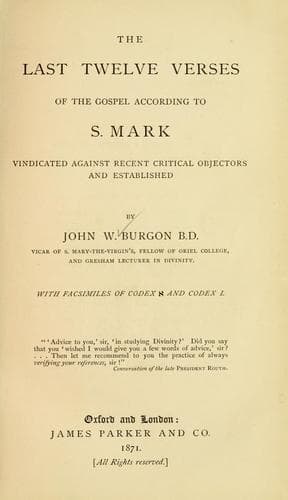
The Last Twelve Verses of the Gospel According to S. MarkBurgon, John William
Religion
The Last Twelve Verses of the Gospel According to S. Mark
Burgon, John William
Bible. Mark XVI, 9-20 -- Criticism, Textual
(5.) I may as well point out _why_ the person who wrote the longer
Scholion says nothing about S. Mark’s Gospel. It is because there was
nothing for him to say. He is enumerating our LORD’S _appearances to His
Disciples_ after His Resurrection; and he discovers that these were
exactly seven in number: _one_ being peculiar to S. Matthew,—_three_, to
S. John,—_three_, to S. Luke. But because, (as every one is aware), there
exists _no_ record of an appearance to the Disciples _peculiar_ to S.
Mark’s Gospel, the Author of the Scholion is silent concerning S. Mark
_perforce_.... How so acute and accomplished a Critic as Matthaei can have
overlooked all this: how he can have failed to recognise the identity of
his longer and his shorter Scholion: how he came to say of the latter,
“conjicias ergo Eusebium hunc totum locum repudiasse;” and, of the former,
“ultimam partem Evangelii Marci videtur tollere:”(583) lastly, how
Tischendorf (1869) can write,—“est enim ejusmodi ut ultimam partem
evangelii Marci, de quo quaeritur, excludat:”(584)—I profess myself unable
to understand.
(6.) The epitomizer however, missing the point of his Author,—besides
enumerating _all_ the appearances of our SAVIOUR which S. Luke anywhere
records,—is further convicted of having injudiciously _invented_ the
negative statement about S. Mark’s Gospel which is occasioning us all this
trouble.
(7.) And yet, by that unlucky sentence of his, he certainly did not mean
what is commonly imagined. I am not concerned to defend him: but it is
only fair to point out that, to suppose he intended _to disallow the end
of S. Mark’s Gospel_, is altogether to misapprehend the gist of his
remarks, and to impute to him a purpose of which he clearly knew nothing.
Note, how he throws his first two statements into a separate paragraph;
contrasts, and evidently _balances_ one against the other: thus,—
κατὰ Μάρκον, μετὰ τὴν ἀνάστασιν οὐ λέγεται ὤφθαι,—κατὰ Ματθαῖον μετὰ τὴν
ἀνάστασιν ὤφθη,—τοῖς μαθηταῖς ἐν τῇ Γαλιλαίᾳ.
Perfectly evident is it that the “plena locutio” so to speak, of the
Writer would have been somewhat as follows:—
“[The first two Evangelists are engaged with our SAVIOUR’S appearance to
His Disciples _in Galilee_: but] by S. Mark, He is _not_—by S. Matthew, He
_is_—related to have been actually _seen_ by them there.
“[The other two Evangelists relate the appearances _in Jerusalem_: and]
according to S. John, &c. &c.
“According to S. Luke,” &c. &c.
(8.) And on passing the “Quaestiones ad Marinum” of Eusebius under review,
I am constrained to admit that the Scholion before us is just such a
clumsy bit of writing as an unskilful person might easily be betrayed
into, who should attempt to exhibit in a few short sentences the substance
of more than one tedious disquisition of this ancient Father.(585) Its
remote parentage would fully account for its being designated “σχόλιον
εὐσεβίου” all the same.
Public-domain text, read in full here on John Shaqi.
Reviews
Reviews
No reviews yet
Be the first to share your thoughts on this work.
Elsewhere in the archive
Join the Discussion
Join the discussion
Sign in to leave a comment or review.
Sign InorCreate an account