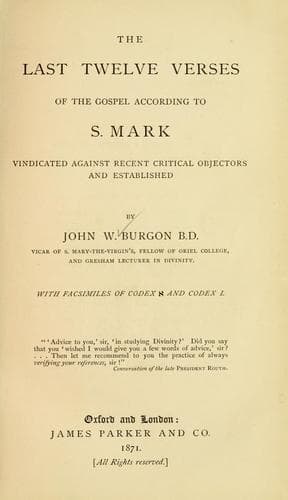
The Last Twelve Verses of the Gospel According to S. MarkBurgon, John William
Religion
The Last Twelve Verses of the Gospel According to S. Mark
Burgon, John William
Bible. Mark XVI, 9-20 -- Criticism, Textual
13 The Rev. F. H. Scrivener, Bp. Ellicott, and Bp. Wordsworth, are
honourable exceptions to this remark. The last-named excellent
Divine reluctantly admitting that “this portion may not have been
penned by S. Mark himself;” and Bishop Ellicott (_Historical
Lectures_, pp. 26-7) asking “Why may not this portion have been
written by S. Mark at a later period?;”—both alike resolutely insist
on its genuineness and canonicity. To the honour of the best living
master of Textual Criticism, the Rev. F. H. Scrivener, (of whom I
desire to be understood to speak as a disciple of his master,) be it
stated that he has never at any time given the least sanction to the
popular outcry against this portion of the Gospel. “Without the
slightest misgiving” he has uniformly maintained the genuineness of
S. Mark xvi. 9-20. (_Introduction_, pp. 7 and 429-32.)
14 “Hæc non a Marco scripta esse argumentis probatur idoneis,” (p.
320.) “Quæ testimonia aliis corroborantur argumentis, ut quod
conlatis prioribus versu 9. parum apte adduntur verba αφ᾽ ἧς ἐκβεβ
item quod singula multifariam a Marci ratione abhorrent.” (p.
322.)—I quote from the 7th Leipsic ed.; but in Tischendorf’s 8th ed.
(1866, pp. 403, 406,) the same verdict is repeated, with the
following addition:—“Quæ quum ita sint, sanæ erga sacrum textum
pietati adversari videntur qui pro apostolicis venditare pergunt qua
a Marco aliena esse tam luculenter docemur.” (p. 407.)
_ 15 Evangelia Apocrypha_, 1853, Proleg. p. lvi.
16 Pp. 253, 7-9.
17 In his first edition (1848, vol. i. p. 163) Dr. Davidson pronounced
it “manifestly untenable” that S. Mark’s Gospel was the last
written; and assigned A.D. 64 as “its most probable” date. In his
second (1868, vol. ii. p. 117), he says:—“When we consider that _the
Gospel was not written till the second century_, internal evidence
loses much of its force against the authenticity of these
verses.”—_Introduction to N.T._
18 Vol. ii. p. 239.
_ 19 Developed Criticism_, [1857], p. 53.
20 Ed. 1847. i. p. 17. He recommends this view to his reader’s
acceptance in five pages,—pp. 216 to 221.
_ 21 Introduction to the Study of the Gospels_, p. 311.
_ 22 Critical and Exegetical Commentary_, 1855, 8vo. pp. 182, 186-92.
23 In the Roman law this principle is thus expressed,—“Ei incumbit
probatio qui dicit, non qui negat.” Taylor _on the Law of Evidence_,
1868, i. p. 369.
24 This is freely allowed by all. “Certiores facti sumus hanc pericopam
jam in secundo sæculo lectam fuisse tanquam hujus evangelii partem.”
Tregelles _N.T._ p. 214.
Public-domain text, read in full here on John Shaqi.
Reviews
Reviews
No reviews yet
Be the first to share your thoughts on this work.
Elsewhere in the archive
Join the Discussion
Join the discussion
Sign in to leave a comment or review.
Sign InorCreate an account