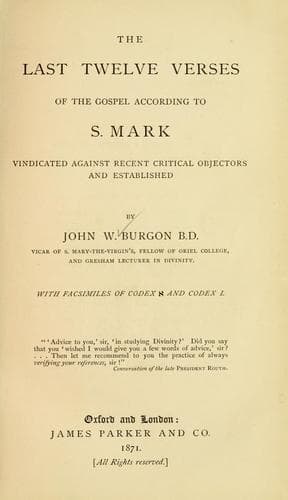
The Last Twelve Verses of the Gospel According to S. MarkBurgon, John William
Religion
The Last Twelve Verses of the Gospel According to S. Mark
Burgon, John William
Bible. Mark XVI, 9-20 -- Criticism, Textual
25 This in fact is how Bengel (N. T. p. 626) accounts for the
phenomenon:—“Fieri potuit ut librarius, scripto versu 8, reliquam
partem scribere differret, et id exemplar, casu non perfectum, alii
quasi perfectum sequerentur, praesertim quum ea pars cum reliquâ
historiâ evangelicâ minus congruere videretur.”
26 It is thus that Tischendorf treats S. Luke xxiv. 12, and (in his
latest edition) S. John xxi. 25.
27 Chap. III.-VIII., also Chap. X.
28 Chap. IX.
29 Viz. E, L, [viii]: K, M, V, Γ, Δ, Λ (quære), Π (Tisch. _ed._ 8va.)
[ix]: G, X, S, U [ix, x]. The following uncials are defective
here,—F (ver. 9-19), H (ver. 9-14), I, N, O, P, Q, R, T, W, Y, Z.
30 See Appendix (A), on the true reading of S. Luke ii. 14.
31 Consider how Ignatius (_ad Smyrn._, c. 3) quotes S. Luke xxiv. 39;
and how he refers to S. John xii. 3 in his Ep. _ad Ephes._ c. 17.
32 Ἱστορεῖ [sc. Παπίας] ἕτερον παράδοξον περὶ Ἰοῦστον τὸν ἐπικληθέντα
Βαρσαβᾶν γεγονὸς,—evidently a slip of the pen for Βαρσαβᾶν τὸν
ἐπικληθέντα Ἰοῦστον (see Acts i. 23, quoted by Eusebius immediately
afterwards,)—ὡς δηλητήριον φάρμακον ἐμπιόντος καὶ μηδὲν ἀηδὲς διὰ
τὴν τοῦ Κυρίου χάριν ὑπομείναντος. Euseb. _Hist. Eccl._ iii. 39.
_ 33 Apol._ I. c. 45.—The supposed quotations in c. 9 from the Fragment
_De Resurrectione_ (Westcott and others) are clearly references to
S. Luke xxiv.,—_not_ to S. Mark xvi.
34 lib. iii. c. x. _ad fin._ (ed. Stieren, i. p. 462). “In fine autem
Evangelii ait Marcus, _et quidem Dominus Jesus, postquam locutus est
sis, receptus est in caelos, et sedet ad dexteram Dei._”
Accordingly, against S. Mark xvi. 19 in Harl. MS. 5647 ( = Evan. 72)
occurs the following marginal scholium, which Cramer has already
published:—Εἰρηναῖος ὁ τῶν Ἀποστόλων πλησίον, ἐν τῷ πρὸς τὰς
αἱρέσεις γ᾽ λόγῳ τοῦτο ἀνήνεγκεν τὸ ῥητον ὡς Μάρκῳ ειρημένον.
35 First published as his by Fabricius (vol. i. 245.) Its authorship
has never been disputed. In the enumeration of the works of
Hippolytus (inscribed on the chair of his marble effigy in the
Lateran Museum at Rome) is read,—ΠΕΡΙ ΧΑΡΙΣΜΑΤΩΝ; and by that name
the fragment in question is actually designated in the third chapter
of the (so called) “Apostolical Constitutions,” (τὰ μὲν σῦν πρῶτα
τοῦ λόγου ἐξεθέμεθα περὶ τῶν Χαρισμάτων, κ.τ.λ.),—in which singular
monument of Antiquity the fragment itself is also found. It is in
fact nothing else but the first two chapters of the “Apostolical
Constitutions;” of which the ivth chapter is also claimed for
Hippolytus, (though with evidently far less reason,) and as such
appears in the last edition of the Father’s collected works,
(_Hippolyti Romani quæ feruntur omnia Græce_, ed. Lagarde, 1858,)—p.
74.
Public-domain text, read in full here on John Shaqi.
Reviews
Reviews
No reviews yet
Be the first to share your thoughts on this work.
Elsewhere in the archive
Join the Discussion
Join the discussion
Sign in to leave a comment or review.
Sign InorCreate an account