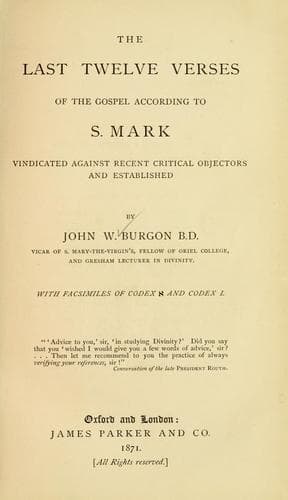
The Last Twelve Verses of the Gospel According to S. MarkBurgon, John William
Religion
The Last Twelve Verses of the Gospel According to S. Mark
Burgon, John William
Bible. Mark XVI, 9-20 -- Criticism, Textual
225 “Frustra ad Ammonium aut Tatianum in Harmoniis provocant. Quæ
supersunt vix quicquam cum Ammonio aut Tatiano commune habent.”
(Tischendorf _on S. Mark_ xvi. 8).—Dr. Mill (1707),—because he
assumed that the anonymous work which Victor of Capua brought to
light in the vith century, and conjecturally assigned to Tatian, was
the lost work of Ammonius, (_Proleg._ p. 63, § 660,)—was of course
warranted in appealing to the authority of Ammonius _in support_ of
the last twelve verses of S. Mark’s Gospel. But in truth Mill’s
assumption cannot be maintained for a moment, as Wetstein has
convincingly shewn. (_Proleg._ p. 68.) Any one may easily satisfy
himself of the fact who will be at the pains to examine a few of the
chapters with attention, bearing in mind what Eusebius has said
concerning the work of Ammonius. Cap. lxxiv, for instance, contains
as follows:—Mtt. xiii. 33, 34. Mk. iv. 33. Mtt. xiii. 34, 35: 10,
11. Mk. iv. 34. Mtt. xiii. 13 to 17. But here it is _S. Matthew’s
Gospel_ which is dislocated,—for verses 10, 11, and 13 to 17 of ch.
xiii. come _after_ verses 33-35; while ver. 12 has altogether
disappeared.
The most convenient edition for reference is Schmeller’s,—_Ammonii
Alexandrini quæ et Tatiani dicitur Harmonia Evangeliorum_. (Vienna,
1841.)
226 Only by the merest license of interpretation can εἰληφὼς ἀφορμάς be
assumed to mean that Eusebius had found the four Gospels ready
divided to his hand by Ammonius into exactly 1165 sections,—every
one of which he had simply adopted for his own. Mill, (who
nevertheless held this strange opinion,) was obliged to invent the
wild hypothesis that Eusebius, _besides_ the work of Ammonius which
he describes, must have found in the library at Cæsarea the private
copy of the Gospels which belonged to Ammonius,—an unique volume, in
which the last-named Father (as he assumes) will have numbered the
Sections and made them exactly 1165. It is not necessary to discuss
such a notion. We are dealing with facts,—not with fictions.
227 For proofs of what is stated above, as well as for several remarks
on the (so-called) “Ammonian” Sections, the reader is referred to
the Appendix (G).
228 See above, p. 128, note (f).
229 See above, p. 125.
230 As a matter of fact, Codices abound in which the Sections are noted
_without_ the Canons, throughout. See more on this subject in the
Appendix (G).
231 τέσσαρα εἰσιν εὐαγγέλια κεφαλαίων χιλίων ἑκατὸν ἑξηκονταδύο. The
words are most unexpectedly, (may I not say _suspiciously_?), found
in Epiphanius, _Ancor._ 50, (_Opp._ ii. 54 B.)
232 By Tischendorf, copying Mill’s _Proleg._ p. 63, § 662:—the fontal
source, by the way, of the twin references to “Epiphanius and
Cæsarius.”
Public-domain text, read in full here on John Shaqi.
Reviews
Reviews
No reviews yet
Be the first to share your thoughts on this work.
Elsewhere in the archive
Join the Discussion
Join the discussion
Sign in to leave a comment or review.
Sign InorCreate an account