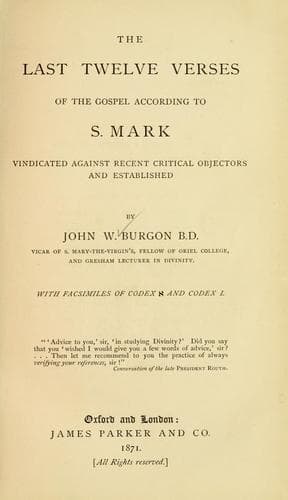
The Last Twelve Verses of the Gospel According to S. MarkBurgon, John William
Religion
The Last Twelve Verses of the Gospel According to S. Mark
Burgon, John William
Bible. Mark XVI, 9-20 -- Criticism, Textual
246 Allusion is made to the Rev. John A. Broadus, D.D.,—“Professor of
Interpretation of the New Testament in the Southern Baptist
Theological Seminary, Greenville, S.C.,”—the author of an able and
convincing paper entitled “Exegetical Studies” in “_The Baptist
Quarterly_” for July, 1869 (Philadelphia), pp. 355-62: in which “the
words and phrases” contained in S. Mark xvi. 9-20 are exclusively
examined.
If the present volume should ever reach the learned Professor’s
hands, he will perceive that I must have written the present Chapter
_before_ I knew of his labours: (an advantage which I owe to Mr.
Scrivener’s kindness:) my treatment of the subject and his own being
so entirely different. But it is only due to Professor Broadus to
acknowledge the interest and advantage with which I have compared my
lucubrations with his, and the sincere satisfaction with which I
have discovered that we have everywhere independently arrived at
precisely the same result.
247 Dr. Kay’s _Crisis Hupfeldiana_, p. 34,—the most masterly and
instructive exposure of Bp. Colenso’s incompetence and presumption
which has ever appeared. Intended specially of _his_ handling of the
writings of Moses, the remarks in the text are equally applicable to
much which has been put forth concerning the authorship of the end
of S. Mark’s Gospel.
248 S. Matth. viii. 1 (καταβάντι αὐτῷ):—5 (εἰσελθόντι τω Ἰ.):—23
(ἐμβάντι αὐτῷ):—28 (ἐλθόντι αὐτῷ):—ix. 27 (παράγοντι τῷ Ἰ.):—28
(ἐλθόντι):—xxi. 23 (ἐλθόντι αὐτῷ).
_ 249 On the Creed_, Art. ii. (vol. i. p. 155.)
250 τῷ μὲν γὰρ ἀληθεῖ πάντα συνᾴδει τὰ ὑπάρχοντα, τῷ δὲ ψευδεῖ ταχὺ
διαφωνεῖ τὰληθές. Aristot. _Eth. Nic._ I. c. vi.
251 Davidson’s _Introduction_, &c. i. 170.
252 And yet, if it were ever so “sententious,” ever so “abrupt;” and if
his “brief notices” were over so “loosely linked together;”—these,
_according to Dr. Davidson_, would only be indications that S. Mark
actually _was_ their Author. Hear him discussing S. Mark’s
“characteristics,” at p. 151:—“In the consecution of his narrations,
Mark _puts them together very loosely_.” “Mark is also characterised
by a _conciseness_ and apparent incompleteness of delineation which
are allied to the obscure.” “The _abrupt_ introduction” of many of
his details is again and again appealed to by Dr. Davidson, and
illustrated by references to the Gospel. What, in the name of common
sense, is the value of such criticism as this? What is to be thought
of a gentleman who blows hot and cold in the same breath: denying at
p. 170 the genuineness of a certain portion of Scripture _because_
it exhibits the very peculiarities which at p. 151 he had
volunteered the information are _characteristic_ of its reputed
Author?
253 N.T. vol. i. _Prolegg._ p. 38.
Public-domain text, read in full here on John Shaqi.
Reviews
Reviews
No reviews yet
Be the first to share your thoughts on this work.
Elsewhere in the archive
Join the Discussion
Join the discussion
Sign in to leave a comment or review.
Sign InorCreate an account