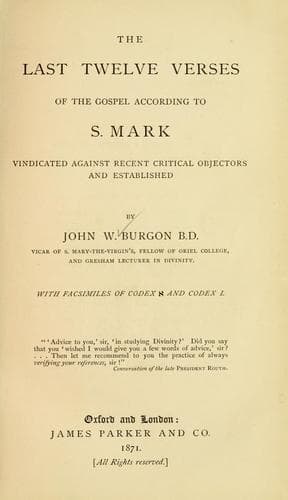
The Last Twelve Verses of the Gospel According to S. MarkBurgon, John William
Religion
The Last Twelve Verses of the Gospel According to S. Mark
Burgon, John William
Bible. Mark XVI, 9-20 -- Criticism, Textual
263 The Sabbath-day, in the Old Testament, is invariably תבש
(_shabbath_): a word which the Greeks could not exhibit more nearly
than by the word σάββατον. The Chaldee form of this word is אתבש
(_shabbatha:_) the final א (_a_) being added for emphasis, as in
Abb_a_, Aceldam_a_, Bethesd_a_, Ceph_a_, Pasch_a_, _&c_.: and this
form,—(I owe the information to my friend Professor
Gandell,)—because it was so familiar to the people of Palestine,
(who spoke Aramaic,) _gave rise to another form of the Greek name
for the Sabbath_,—viz. σάββατα: which, naturally enough, attracted
the article (τό) into agreement with its own (apparently) plural
form. By the Greek-speaking population of Judæa, the Sabbath day was
therefore indifferently called το σαββατον and τα σαββατα: sometimes
again, η ημερα του σαββατου, and sometimes η ημερα των σαββατων.
Σάββατα, although plural in sound, was strictly singular in sense.
(Accordingly, it is _invariably_ rendered “_Sabbatum_” in the
Vulgate.) Thus, in Exod. xvi. 23,—σάββατα ἀνάπαυσις ἁγία τῷ Κυρίῳ:
and 25,—ἔστι γὰρ σάββατα ἀνάπαυσις τῷ Κυρίῳ. Again,—τῇ δὲ ἡμέρα τῇ
ἑβδόμη σάββατα. (Exod. xvi. 26: xxxi. 14. Levit. xxiii. 3.) And in
the Gospel, what took place on _one definite Sabbath-day_, is said
to have occurred ἐν τοῖς σάββασι (S. Luke xiii. 10. S. Mark xii. 1.)
It will, I believe, be invariably found that the form ἐν τοῖς
σάββασι is strictly equivalent to ἐν τῷ σαββάτῳ; and was adopted for
convenience in contradistinction to ἐν τοῖς σαββάτοις (1 Chron.
xxiii. 31 and 2 Chron. ii. 4) where Sabbath _days_ are spoken of.
It is not correct to say that in Levit. xxiii. 15 תותבש is put for
“weeks;” though the Septuagint translators have (reasonably enough)
there rendered the word ἑβδομάδας. In Levit. xxv. 8, (where the same
word occurs twice,) it is once rendered ἀναπαύσεις; once, ἑβδομάδες.
Quite distinct is עובש (_shavooa_) i.e. ἑβδομάς; nor is there any
substitution of the one word for the other. But inasmuch as the
recurrence of the _Sabbath-day_ was what constituted _a week_; in
other words, since the essential feature of a week, as a Jewish
division of time, was the recurrence of the Jewish day of rest;—τὸ
σάββατον or τὰ σάββατα, the Hebrew name for _the day of rest_,
became transferred to _the week_. The former designation, (as
explained in the text,) is used once by S. Mark, once by S. Luke;
while the phrase μία τῶν σαββάτων occurs in the N.T., in all, six
times.
Public-domain text, read in full here on John Shaqi.
Reviews
Reviews
No reviews yet
Be the first to share your thoughts on this work.
Elsewhere in the archive
Join the Discussion
Join the discussion
Sign in to leave a comment or review.
Sign InorCreate an account