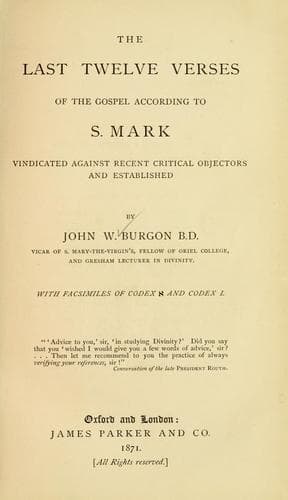
The Last Twelve Verses of the Gospel According to S. MarkBurgon, John William
Religion
The Last Twelve Verses of the Gospel According to S. Mark
Burgon, John William
Bible. Mark XVI, 9-20 -- Criticism, Textual
311 Acts i. 22, 23. Cf. ver. 2,—ἄχρι ἧς ἡμέρας ... ἀνελήφθη.
312 S. Mark x. 6: xiii. 19.—2 S. Pet. iii. 4 (Cf. 1 S. Pet. ii. 13.)
313 Is. lxvi. 2.
314 See above, p. 143-5.
315 See above, p. 174-5.
316 My attention was first drawn to this by my friend, the Rev. W. Kay,
D.D.
317 The Creed itself, (“ex variis Cyrillianarum Catacheseon locis
collectum,”) may be seen at p. 84 of De Touttée’s ed. of Cyril. Let
the following be compared:—
ἀνελήφθη εἰς τὸν οὐρανόν, καὶ ἐκάθισεν ἐκ δεξιῶν τοῦ Θεοῦ (ch. xvi.
19.)
ἈΝΕΛΘΌΝΤΑ ΕἸΣ ΤΟῪΣ ΟῪΡΑΝΟῪΣ, ΚΑῚ ΚΑΘΊΣΑΝΤΑ ἘΚ ΔΕΞΙΩΝ ΤΟΥ ΠΑΤΡΟΣ
(ART. VI.) This may be seen _in situ_ at p. 224 C of Cyril.
βάπτισμα μετανοίας εἰς ἄφεσιν ἁμαρτιῶν (ch. i. 4.)
ΒΑΠΤΙΣΜΑ ΜΕΤΑΝΟΙΑΣ ΕΙΣ ΑΦΕΣΙΝ ΑΜΑΡΤΙΩΝ (ART. X.) This may be seen at
p. 295 C of Cyril.
The point will be most intelligently and instructively studied in
Professor Heurtley’s little work _De Fide et Symbolo_, 1869, p. 9.
318 See above,—p. 165-6.
_ 319 Cod. Bobbiensis_ (k): which however for “illis” has “et:” for
“Petro,” “puero:” and for “occidentem,” “orientem.” It also repeats
“usque.” I have ventured to alter “ab orientem” into “ab
oriente.”—Compare what is found in the Philoxenian margin, as given
by White and Adler.
320 See above (Art. II.) p. 152-3.
321 Consider S. Luke xxiv. 9: 33. Acts ii. 14.
322 S. Matth. xxvi. 14, 29, 47.—S. Mark iv. 10: vi. 7: ix. 35: x. 32:
xi. 11: xiv. 10, 17, 20, 43.—S. Luke viii. 1: ix. 1, 12: xviii. 31:
xxii. 8, 47.—S. John vi. 37, 70, 71: xx. 24.
323 Compare S. Luke xxii. 39; and especially S. John xviii. 1,—where the
moment of departure _from the city_ is marked: (for observe, they
had left the house and the upper chamber at ch. xiv. 31). See also
ch. xix. 17,—where the going _without the gate_ is indicated: (for
ἔξω τῆς πύλης ἔπαθε [Heb. xiii. 12.]) So Matth. xxvii. 32. Consider
S. Luke xxi. 37.
324 S. Luke xxiv. 49. Acts i. 4.
325 See above, p. 2.
326 The one memorable exception, which I have only lately met with, is
supplied by the following remark of the thoughtful and accurate
Matthaei, made in a place where it was almost safe to escape
attention; viz. in a footnote at the very end of his _Nov. Test._
(ed. 1803), vol. i. p. 748.—“Haec lectio in Evangeliariis et
Synaxariis omnibus ter notatur tribus maxime notabilibus temporibus.
Secundum ordinem temporum Ecclesiae Graecae primo legitur κυριακῇ
τῶν μυροφόρων, εἰς τὸν ὄρθρον. Secundo, τῷ ὄρθρῳ τῆς ἀναλήψεως.
Tertio, ut ἑωθινὸν ἀναστάσιμον γ᾽. De hoc loco ergo vetustissimis
temporibus nullo modo dubitavit Ecclesia.”—Matthaei had slightly
anticipated this in his ed. of 1788, vol. ii. 267.
327 Τὰς τῶν ἱερῶν ἀποστόλων διαδοχάς,—are _the first words_ of the
Ecclesiatical History of Eusebius.
Public-domain text, read in full here on John Shaqi.
Reviews
Reviews
No reviews yet
Be the first to share your thoughts on this work.
Elsewhere in the archive
Join the Discussion
Join the discussion
Sign in to leave a comment or review.
Sign InorCreate an account