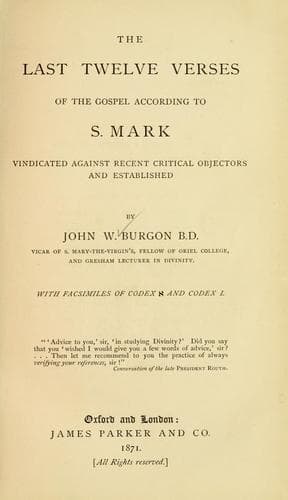
The Last Twelve Verses of the Gospel According to S. MarkBurgon, John William
Religion
The Last Twelve Verses of the Gospel According to S. Mark
Burgon, John William
Bible. Mark XVI, 9-20 -- Criticism, Textual
302 The reader will be perhaps interested with the following passage in
the pages of Professor Broadus already (p. 139 note g) alluded
to:—“It occurred to me to examine the twelve just preceding verses,
(xv. 44 to xvi. 8,) and by a curious coincidence, the words and
expressions not elsewhere employed by Mark, footed up precisely the
same number, seventeen. Those noticed are the following (text of
Tregelles):—ver. 44, τέθηκεν (elsewhere ἀποθνήσκο):—ver. 45, γνοὺς
ἀπό, a construction found nowhere else in the New Testament: also
ἐδωρήσατο and πτῶμα: ver. 46, ἐνείλησεν, λελατομημένον, πέτρας,
προσεκύλισεν:—chap. xvi. ver. 1, διαγενομένου, and ἀρώματα: ver. 2,
μιᾷ τῶν σαββάτων:—ver. 3, ἀποκυλίσει:—ver. 4, ἀνεκεκύλισται. Also,
σφόδρα, (Mark’s word is λίαν.) Ver. 5, ἀν τοῖς δεξιοῖς is a
construction not found in Mark, or the other Gospels, though the
word δεξιός occurs frequently:—ver. 8, εἶχεν, in this particular
sense, not elsewhere in the New Testament: τρόμος.
“This list is perhaps not complete, for it was prepared in a few
hours—about as much time, it may be said, without disrespect, as
Fritsche and Meyer appear to have given to their collections of
examples from the other passage. It is not proposed to discuss the
list, though some of the instances are curious. It is not claimed
that they are all important, but that they are all real. And as
regards the single question of the _number_ of peculiarities, they
certainly form quite an offset to the number upon which Dean Alford
has laid stress.”—p. 361.
303 Tischendorf, Tregelles, Alford.
304 S. Mark i. 9: 14: 20.
305 The same word is found also in S. Luke’s narrative of the same
event, ch. xxiv. 13.
306 On which, Victor of Antioch (if indeed it be he) finely
remarks,—Σχίζονται δὲ οἱ οὐρονοὶ, ἢ κατὰ Ματθαον ἀνοίγονται, ἵνα
τοῖς ἀνθρώποις ἀποδοθῇ ἐξ οὐρανοῦ ὁ ἁγιασμὸς, καὶ συναφθῇ τος
ἐπιγείοις τὰ οὐράνια.—(Cramer i. p. 271.)
307 Disc. v. Sect. ii.
308 This appears to be the true reading.
309 So Chrysostom:—ὁ δὲ Μάρκος φησὶν, ὅτι “καθαρίζων τὰ βρώματα,” ταῦτα
ἔλεγεν. [vii. 526 a].—He seems to have derived that remark from
Origen [_in Matth._ ed. Huet. i. 249 D]:—κατὰ τὸν Μάρκον ἔλεγε ταῦτα
ὁ Σωτὴρ “καθαρίζων πάντα τὰ βρώματα.”—From the same source, I
suspect, Gregory Thaumaturgus (Origen’s disciple), Bp. of Neocæsarea
in Pontus, A.D. 261, [_Routh_, iii. 257] derived the following:—καὶ
ὁ Σωτὴρ ὁ “πάντα καθαρίζων τὰ βρώματα” οὐ τὸ εἰσπορευόμενον, φησὶ,
κοινοῖ τὸν ἄνθρωπον, ἀλλὰ τὸ ἐκπορευόμενον.—See, by all means,
Field’s most interesting _Adnotationes in Chrys._, vol. iii. p.
112.... Εντευθεν (finely says Victor of Antioch) ὁ καινὸς ἄρχεται
νόμος ὁ κατὰ τὸ πνεῦμα. (_Cramer_ i. 335.)
310 Acts x. 15.
Public-domain text, read in full here on John Shaqi.
Reviews
Reviews
No reviews yet
Be the first to share your thoughts on this work.
Elsewhere in the archive
Join the Discussion
Join the discussion
Sign in to leave a comment or review.
Sign InorCreate an account