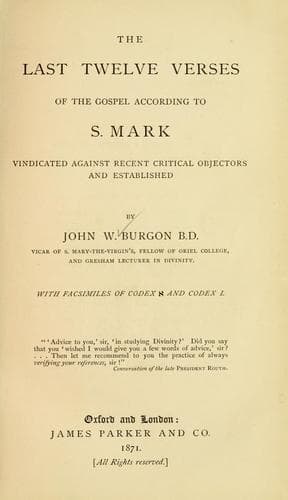
The Last Twelve Verses of the Gospel According to S. MarkBurgon, John William
Religion
The Last Twelve Verses of the Gospel According to S. Mark
Burgon, John William
Bible. Mark XVI, 9-20 -- Criticism, Textual
XV. and XVI. Another very important testimony to the genuineness of the
concluding part of S. Mark’s Gospel is furnished by the unhesitating
manner in which NESTORIUS, the heresiarch, quotes ver. 20; and CYRIL of
ALEXANDRIA accepts his quotation, adding a few words of his own.(55) Let
it be borne in mind that this is tantamount to the discovery of _two_
dated codices containing the last twelve verses of S. Mark,—and _that_
date _anterior_ (it is impossible to say by how many years) to A.D. 430.
XVII. VICTOR OF ANTIOCH, (concerning whom I shall have to speak very
largely in Chapter V.,) flourished about A.D. 425. The critical testimony
which he bears to the genuineness of these verses is more emphatic than is
to be met with in the pages of any other ancient Father. It may be
characterized as the most conclusive testimony which it was in his power
to render.
XVIII. HESYCHIUS of Jerusalem, by a singular oversight, has been reckoned
among the impugners of these verses. He is on the contrary their eager
advocate and champion. It seems to have escaped observation that towards
the close of his “Homily on the Resurrection,” (published in the works of
Gregory of Nyssa, and erroneously ascribed to that Father,) Hesychius
appeals to the 19th verse, and quotes it as S. Mark’s at length.(56) The
date of Hesychius is uncertain; but he may, I suppose, be considered to
belong to the vith century. His evidence is discussed in Chapter V.
XIX. This list shall be brought to a close with a reference to the
SYNOPSIS SCRIPTURAE SACRAE,—an ancient work ascribed to Athanasius,(57)
but probably not the production of that Father. It is at all events of
much older date than any of the later uncials; and it rehearses in detail
the contents of S. Mark xvi. 9-20.(58)
It would be easy to prolong this enumeration of Patristic authorities; as,
by appealing to Gregentius in the vith century, and to Gregory the Great,
and Modestus, patriarch of Constantinople in the viith;—to Ven. Bede and
John Damascene in the viiith;—to Theophylact in the xith;—to Euthymius in
the xiith(59): but I forbear. It would add no strength to my argument that
I should by such evidence support it; as the reader will admit when he has
read my Xth chapter.
It will be observed then that _three_ competent Patristic witnesses of the
iind century,—_four_ of the iiird,—_six_ of the ivth,—_four_ of the
vth,—and _two_ (of uncertain date, but probably) of the vith,—have
admitted their familiarity with these “last Twelve Verses.” Yet do they
not belong to one particular age, school, or country. They come, on the
contrary, from every part of the ancient Church: Antioch and
Constantinople,—Hierapolis, Cæsarea and Edessa,—Carthage, Alexandria and
Hippo,—Rome and Portus. And thus, upwards of nineteen early codexes have
been to all intents and purposes inspected for us in various lands by
unprejudiced witnesses,—_seven_ of them at least of more ancient date than
the oldest copy of the Gospels extant.
Public-domain text, read in full here on John Shaqi.
Reviews
Reviews
No reviews yet
Be the first to share your thoughts on this work.
Join the Discussion
Join the discussion
Sign in to leave a comment or review.
Sign InorCreate an account