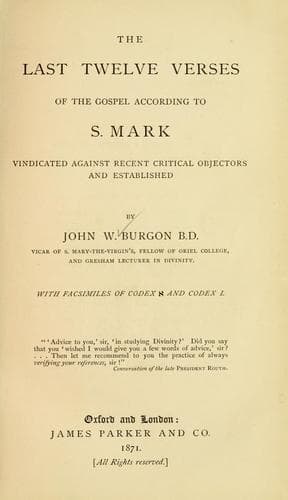
The Last Twelve Verses of the Gospel According to S. MarkBurgon, John William
Religion
The Last Twelve Verses of the Gospel According to S. Mark
Burgon, John William
Bible. Mark XVI, 9-20 -- Criticism, Textual
And from the familiar style in which this Father’s name is always
introduced into the present discussion, no less than from the invariable
practice of assigning to him the date “A.D. 401,” it might be supposed
that “Victor of Antioch” is a well-known personage. Yet is there scarcely
a Commentator of antiquity about whom less is certainly known. Clinton
(who enumerates cccxxii “Ecclesiastical Authors” from A.D. 70 to A.D.
685(104)) does not even record his name. The recent “Dictionary of Greek
and Roman Biography” is just as silent concerning him. Cramer (his latest
editor) calls his very existence in question; proposing to attribute his
Commentary on S. Mark to Cyril of Alexandria.(105) Not to delay the reader
needlessly,—Victor of Antioch is an interesting and unjustly neglected
Father of the Church; whose date,—(inasmuch as he apparently quotes
sometimes from Cyril of Alexandria who died A.D. 444, and yet seems to
have written soon after the death of Chrysostom, which took place A.D.
407), may be assigned to the first half of the vth century,—suppose A.D.
425-450. And in citing him I shall always refer to the best (and most
easily accessible) edition of his work,—that of Cramer (1840) in the first
volume of his “Catenae.”
But a far graver charge is behind. From the confident air in which
Victor’s authority is appealed to by those who deem the last twelve verses
of S. Mark’s Gospel spurious, it would of course be inferred that his
evidence is hostile to the verses in question; whereas his evidence to
their genuineness is the most emphatic and extraordinary on record. Dr.
Tregelles asserts that “his _testimony_ to the absence of these twelve
verses from some or many copies, stands in contrast to his own _opinion_
on the subject.” But Victor delivers _no_ “opinion:” and his “testimony”
is the direct reverse of what Dr. Tregelles asserts it to be. This learned
and respected critic has strangely misapprehended the evidence.(106)
I must needs be brief in this place. I shall therefore confine myself to
those facts concerning “Victor of Antioch,” or rather concerning his work,
which are necessary for the purpose in hand.(107)
Public-domain text, read in full here on John Shaqi.
Reviews
Reviews
No reviews yet
Be the first to share your thoughts on this work.
Join the Discussion
Join the discussion
Sign in to leave a comment or review.
Sign InorCreate an account