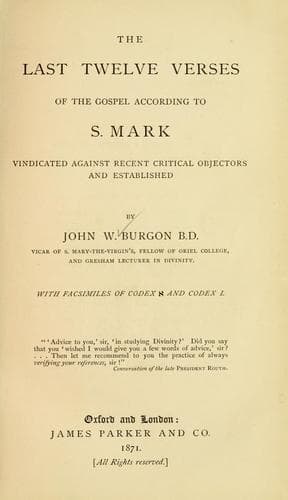
The Last Twelve Verses of the Gospel According to S. MarkBurgon, John William
Religion
The Last Twelve Verses of the Gospel According to S. Mark
Burgon, John William
Bible. Mark XVI, 9-20 -- Criticism, Textual
Accordingly, it does not at all surprise me to discover that in both
Codices the important word ἐξελθοῦσαι (in S. Matth. xxviii. 8) has been
altered into απελθουσαι. I recognise in that substitution of απο for ἔξ
the hand of one who was not aware that the women, when addressed by the
Angel, were _inside the sepulchre_; but who accepted the belief (it is
found to have been as common in ancient as in modern times) that they
beheld him “sitting on the stone.”(146)—In consequence of a similar
misconception, both Codices are observed to present us with the word
“_wine_” instead of “_vinegar_” in S. Matthew’s phrase ὄξος μετὰ χολῆς
μεμνγμένον: which results from a mistaken endeavour on the part of some
ancient critic to bring S. Matth. xxvii. 34 into harmony with S. Mark xv.
23. The man did not perceive that the cruel insult of the “vinegar and
gall” (which the SAVIOUR tasted but would not drink) was quite a distinct
thing from the proffered mercy of the “myrrhed wine” which the SAVIOUR put
away from Himself altogether.
So again, it was in order to bring S. Luke xxiv. 13 into harmony with a
supposed fact of geography that Cod. א states that Emmaus, (which Josephus
also places at sixty stadia from Jerusalem), was “_an hundred_ and sixty”
stadia distant. The history of this interpolation of the text is known. It
is because some ancient critic (Origen probably) erroneously assumed that
_Nicopolis_ was the place intended. The conjecture met with favour, and
there are not wanting scholia to declare that this was the reading of “the
accurate” copies,—notwithstanding the physical impossibility which is
involved by the statement.(147)—Another geographical misconception under
which the scribe of Cod. א is found to have laboured was that Nazareth (S.
Luke i. 26) and Capernaum (S. Mark i. 28) were _in Judæa_. Accordingly he
has altered the text in both the places referred to, to suit his private
notion.(148)—A yet more striking specimen of the preposterous method of
the same scribe is supplied by his substitution of Καισαριας for Σαμαρείας
in Acts viii. 5,—evidently misled by what he found in viii. 40 and xxi.
8.—Again, it must have been with a view of bringing Revelation into
harmony with the (supposed) facts of physical Science that for the highly
significant Theological record καὶ ἐσκοτίσθη ὁ ἥλιος at the
Crucifixion,(149) has been substituted both in B and א, του ηλιου
εκλιποντος,—a statement which (as the ancients were perfectly well
aware(150)) introduces into the narrative an astronomical
contradiction.—It may be worth adding, that Tischendorf with singular
inconsistency admits into his text the astronomical contradiction, while
he rejects the geographical impossibility.—And this may suffice concerning
the text of Codices B and א.
Public-domain text, read in full here on John Shaqi.
Reviews
Reviews
No reviews yet
Be the first to share your thoughts on this work.
Elsewhere in the archive
Join the Discussion
Join the discussion
Sign in to leave a comment or review.
Sign InorCreate an account