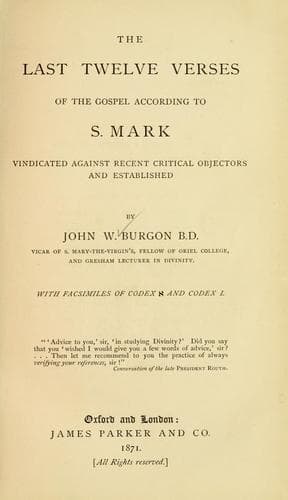
The Last Twelve Verses of the Gospel According to S. MarkBurgon, John William
Religion
The Last Twelve Verses of the Gospel According to S. Mark
Burgon, John William
Bible. Mark XVI, 9-20 -- Criticism, Textual
III. We are by this time in a condition to form a truer estimate of the
value of the testimony borne by these two manuscripts in respect of the
last twelve verses of S. Mark’s Gospel. If we were disposed before to
regard their omission of an important passage as a serious matter, we
certainly cannot any longer so regard it. We have by this time seen enough
to disabuse our minds of every prejudice. Codd. B and א are the very
reverse of infallible guides. Their deflections from the Truth of
Scripture are more constant, as well as more licentious by far, than those
of their younger brethren: their unauthorized omissions from the sacred
text are not only far more frequent but far more flagrant also. And yet
the main matter before us,—_their omission of the last twelve verses of S.
Mark’s Gospel_,—when rightly understood, proves to be an entirely
different phenomenon from what an ordinary reader might have been led to
suppose. Attention is specially requested for the remarks which follow.
IV. To say that in the Vatican Codex (B), which is unquestionably the
oldest we possess, S. Mark’s Gospel ends abruptly at the 8th verse of the
xvith chapter, and that the customary subscription (ΚΑΤΑ ΜΑΡΚΟΝ)
follows,—is true; but it is far from being _the whole_ truth. It requires
to be stated in addition that the scribe, whose plan is found to have been
to begin every fresh book of the Bible at the top of _the next ensuing
column_ to that which contained the concluding words of the preceding
book, has at the close of S. Mark’s Gospel deviated from his else
invariable practice. He has left in this place one column entirely vacant.
It is _the only vacant column_ in the whole manuscript;—a blank space
_abundantly sufficient to contain the twelve verses which he nevertheless
withheld. Why_ did he leave that column vacant? _What_ can have induced
the scribe on this solitary occasion to depart from his established rule?
The phenomenon,—(I believe I was the first to call distinct attention to
it,)—is in the highest degree significant, and admits of only one
interpretation. _The older MS._ from which Cod. B was copied must have
infallibly _contained_ the twelve verses in dispute. The copyist was
instructed to leave them out,—and he obeyed: but he prudently left a blank
space _in memoriam rei_. Never was blank more intelligible! Never was
silence more eloquent! By this simple expedient, strange to relate, the
Vatican Codex is made to _refute itself_ even while it seems to be bearing
testimony against the concluding verses of S. Mark’s Gospel, by
withholding them: for it forbids the inference which, under ordinary
circumstances, must have been drawn from that omission. It does more. By
_leaving room_ for the verses it omits, it brings into prominent notice at
the end of fifteen centuries and a half, _a more ancient witness than
itself_. The venerable Author of the original Codex from which Codex B was
copied, is thereby brought to view. And thus, our supposed adversary
Public-domain text, read in full here on John Shaqi.
Reviews
Reviews
No reviews yet
Be the first to share your thoughts on this work.
Elsewhere in the archive
Join the Discussion
Join the discussion
Sign in to leave a comment or review.
Sign InorCreate an account