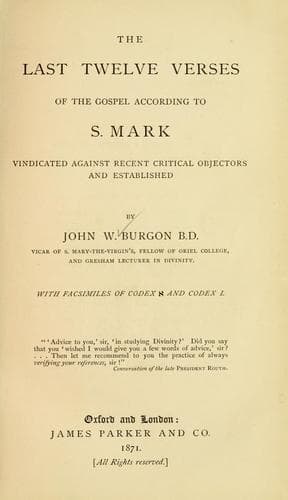
The Last Twelve Verses of the Gospel According to S. MarkBurgon, John William
Religion
The Last Twelve Verses of the Gospel According to S. Mark
Burgon, John William
Bible. Mark XVI, 9-20 -- Criticism, Textual
“For it is high time to point out that even if it so happened that the
oldest known MS. was observed to be without these twelve concluding
verses, it would still remain a thing unproved (not to say highly
improbable) that from the autograph of the Evangelist himself they were
also away. Supposing, further, that no Ecclesiastical writer of the iind
or iiird century could be found who quoted them: even so, it would not
follow that there existed no such verses for a primitive Father to quote.
The earliest of the Versions might in addition yield faltering testimony;
but even so, _who_ would be so rash as to raise on such a slender basis
the monstrous hypothesis, that S. Mark’s Gospel when it left the hands of
its inspired Author was without the verses which at present conclude it?
How, then, would you have proposed to account for the consistent testimony
of an opposite kind yielded by every other known document in the world?
“But, on the other hand, what are the facts of the case? (1) The earliest
of the Fathers,—(2) the most venerable of the Versions,—(3) the oldest MS.
of which we can obtain any tidings,—_all_ are observed to _recognize these
Verses_. ‘Cadit quaestio’ therefore. The last shadow of pretext has
vanished for maintaining with Tischendorf that ‘Mark the Evangelist knew
nothing of’ these verses:—with Tregelles that ‘The book of Mark himself
extends no further than ἐφοβοῦντο γάρ:’—with Griesbach that ‘the _last
leaf of the original Gospel was probably torn away_.’... It is high time,
I say, that this case were dismissed. But there are also costs to be paid.
Cod. B and Cod. א are convicted of being ‘two false witnesses,’ and must
be held to go forth from this inquiry with an injured reputation.”
This entire subject is of so much importance that I must needs yet awhile
crave the reader’s patience and attention.
CHAPTER VII.
MANUSCRIPT TESTIMONY SHEWN TO BE OVERWHELMINGLY IN FAVOUR OF THESE
VERSES.—PART II.
The other chief peculiarity of Codices B and א (viz. the omission
of the words ἐν Ἐφέσῳ from Ephes. i. 1) considered.—Antiquity
unfavourable to the omission of those words (p. 93).—The Moderns
infelicitous in their attempts to account for their omission (p.
100).—Marcion probably the author of this corruption of the Text
of Scripture (p. 106).—Other peculiarities of Codex א disposed of
(p. 109).
The subject which exclusively occupied our attention throughout the
foregoing chapter admits of apt and powerful illustration. Its vast
importance will be a sufficient apology for the particular disquisition
which follows, and might have been spared, but for the plain challenge of
the famous Critic to be named immediately.
“There are two remarkable readings,” (says Tischendorf, addressing English
readers on this subject in 1868,) “which are very instructive towards
determining the age of the manuscripts [א and B], and _their authority_.”
He proceeds to adduce,—
Public-domain text, read in full here on John Shaqi.
Reviews
Reviews
No reviews yet
Be the first to share your thoughts on this work.
Elsewhere in the archive
Join the Discussion
Join the discussion
Sign in to leave a comment or review.
Sign InorCreate an account