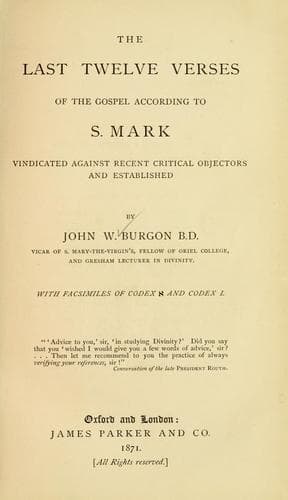
The Last Twelve Verses of the Gospel According to S. MarkBurgon, John William
Religion
The Last Twelve Verses of the Gospel According to S. Mark
Burgon, John William
Bible. Mark XVI, 9-20 -- Criticism, Textual
1. The absence from both, of the last Twelve Verses of S. Mark’s
Gospel,—concerning which, the reader probably thinks that by this time he
has heard enough. Next,—
2. He appeals to their omission of the words ἐν Ἐφέσῳ from the first verse
of S. Paul’s Epistle to the Ephesians,—_another peculiarity, in which
Codd._ א _and B stand quite alone among MSS._
I. Here is an extraordinary note of sympathy between two copies of the New
Testament indeed. Altogether unique is it: and that it powerfully
corroborates the general opinion of their high antiquity, no one will
deny. But how about “their _authority_”? Does the coincidence also raise
our opinion of _the trustworthiness of the Text_, which these two MSS.
concur in exhibiting? for _that_ is the question which has to be
considered,—the _only_ question. The ancientness of a reading is one
thing: its genuineness, (as I have explained elsewhere,) quite another.
The questions are entirely distinct. It may even be added that while the
one is really of little moment, the latter is of all the importance in the
world. I am saying that it matters very little whether Codd. א and B were
written in the beginning of the ivth century, or in the beginning of the
vth: whereas it matters much, or rather it matters _everything_, whether
they exhibit the Word of GOD faithfully, or occasionally with scandalous
license. How far the reading which results from the suppression of the
last two words in the phrase τοῖς ἀγίοις τοῖς οὖσιν ἐν Ἐφέσῳ, is
_critically allowable_ or not, I forbear to inquire. That is not the point
which we have to determine. The one question to be considered is,—May it
_possibly_ be the true reading of the text after all? Is it any way
_credible_ that S. Paul began his Epistle to the Ephesians as
follows:—Παῦλος ἀπόστολος Ἰησοῦ Χριστοῦ διὰ θελήματος Θεοῦ, τοῖς ἁγίοις
τοῖς οὖσι καὶ πιστοῖς ἐν Χριστῷ Ἰησοῦ?... If it be eagerly declared in
reply that the thing is simply incredible: that the words ἐν Ἐφέσῳ are
required for the sense; and that the commonly received reading is no doubt
the correct one: then,—there is an end of the discussion. Two
extraordinary notes of sympathy between two Manuscripts will have been
appealed to as crucial proofs of the _trustworthiness of the Text_ of
those Manuscripts: (for of their high _Antiquity_, let me say it once
more, there can be no question whatever:) and it will have been proved in
one case,—admitted in the other,—that _the omission is unwarrantable_.—If,
however, on the contrary, it be maintained that the words ἐν Ἐφέσῳ
probably had no place in the original copy of this Epistle, but are to be
regarded as an unauthorized addition to it,—then, (as in the case of the
Twelve Verses omitted from the end of S. Mark’s Gospel, and which it was
_also_ pretended are an unauthorized supplement,) we demand to be shewn
the evidence on the strength of which this opinion is maintained, in order
that we may ascertain what it is precisely worth.
Public-domain text, read in full here on John Shaqi.
Reviews
Reviews
No reviews yet
Be the first to share your thoughts on this work.
Elsewhere in the archive
Join the Discussion
Join the discussion
Sign in to leave a comment or review.
Sign InorCreate an account