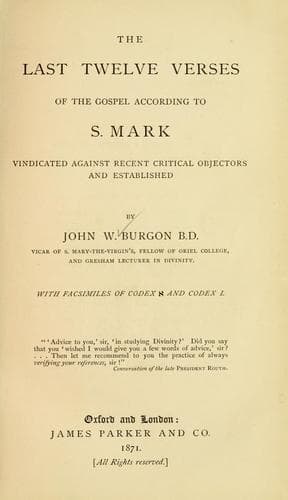
The Last Twelve Verses of the Gospel According to S. MarkBurgon, John William
Religion
The Last Twelve Verses of the Gospel According to S. Mark
Burgon, John William
Bible. Mark XVI, 9-20 -- Criticism, Textual
Thus, I profess myself wholly unable to accept the suggestion of
Ussher,—(which, however, found favour with Garnier (Basil’s editor),
Bengel, Benson, and Michaelis; and has since been not only eagerly
advocated by Conybeare and Howson following a host of German Critics, but
has even enjoyed Mr. Scrivener’s distinct approval;)—that the Epistle to
the Ephesians “was _a Circular_ addressed to other Asiatic Cities besides
the capital Ephesus,—to Laodicea perhaps among the rest (Col. iv. 16); and
that while some Codices may have contained the name of Ephesus in the
first verse, _others may have had another city substituted, or the space
after_ τοῖς οὔσιν _left utterly void_.”(172) At first sight, this
conjecture has a kind of interesting plausibility which recommends it to
our favour. On closer inspection,—(i) It is found to be not only
gratuitous; but (ii) altogether unsupported and unsanctioned by the known
facts of the case; and (what is most to the purpose) (iii) it is, as I
humbly think, demonstrably erroneous. I demur to it,—
(1) Because of its exceeding Improbability: for (_a_) when S. Paul sent
his Epistle to the Ephesians we know that Tychicus, the bearer of it,(173)
was charged with _a distinct Epistle_ to the Colossians:(174) an Epistle
nevertheless so singularly like the Epistle to the Ephesians that it is
scarcely credible S. Paul would have written those two several Epistles to
two of the Churches of Asia, and yet have sent only a duplicate of one of
them, (_that_ to the Ephesians,) furnished with a different address, to so
large and important a place as Laodicea, for example, (_b_) Then further,
the provision which S. Paul made at this very time for communicating with
the Churches of Asia which he did not separately address is found to have
been different. The Laodiceans were to read in their public assembly S.
Paul’s “_Epistle to the Colossians_,” which the Colossians were ordered to
send them. The Colossians in like manner were to read the Epistle,—(to
whom addressed, we know not),—which S. Paul describes as τὴν ἐκ
Λαοδικείας.(175) If then it had been S. Paul’s desire that the Laodiceans
(suppose) should read publicly in their Churches his Epistle to the
Ephesians, surely, he would have charged the Ephesians to procure that
_his Epistle to them should be read in the Church of the Laodiceans_. Why
should the Apostle be gratuitously assumed to have simultaneously adopted
one method with the Churches of _Colosse_ and Laodicea,—another with the
Churches of _Ephesus_ and Laodicea,—in respect of his epistolary
communications?
Public-domain text, read in full here on John Shaqi.
Reviews
Reviews
No reviews yet
Be the first to share your thoughts on this work.
Elsewhere in the archive
Join the Discussion
Join the discussion
Sign in to leave a comment or review.
Sign InorCreate an account