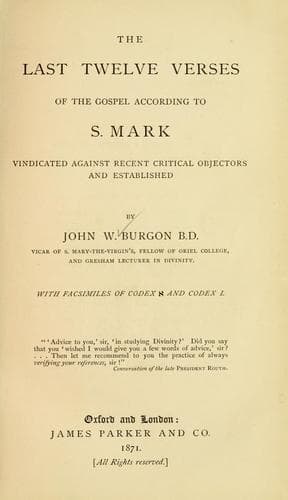
The Last Twelve Verses of the Gospel According to S. MarkBurgon, John William
Religion
The Last Twelve Verses of the Gospel According to S. Mark
Burgon, John William
Bible. Mark XVI, 9-20 -- Criticism, Textual
exist one single instance in the whole of the New Testament_ of a reading
even probably correct in which the four following notes of spurious origin
concur,—which nevertheless are observed to attach to the two readings
which have been chiefly discussed in the foregoing pages: viz.
1. The adverse testimony of _all the uncial MSS. except two_.
2. The adverse testimony of all, or _very nearly all_, the cursive MSS.
3. The adverse testimony of _all the Versions_, without exception.
4. The adverse testimony of _the oldest Ecclesiastical Writers_.
To which if I do not add, as I reasonably might,—
5. _The highest inherent improbability_,—it is only because I desire to
treat this question purely as one of _Evidence_.
II. Learned men have tasked their ingenuity _to account for_ the
phenomenon on which we have been bestowing so many words. The endeavour is
commendable; but I take leave to remark in passing that if we are to set
about discovering reasons at the end of fifteen hundred years for every
corrupt reading which found its way into the sacred text during the first
three centuries subsequent to the death of S. John, we shall have enough
to do. Let any one take up the Codex Bezae, (with which, by the way, Cod.
B shews marvellous sympathy(170),) and explain if he can why there is a
grave omission, or else a gross interpolation, in almost every page; and
how it comes to pass that Cod. D “reproduces the ‘textus receptus’ of the
Acts much in the same way that one of the best Chaldee Targums does the
Hebrew of the Old Testament; so wide are the variations in the diction, so
constant and inveterate the practice of expounding the narrative by means
of interpolations which seldom recommend themselves as genuine by even a
semblance of internal probability.”(171) Our business as Critics is not
_to invent theories_ to account for the errors of Copyists; but rather to
ascertain where they have erred, where not. What with the inexcusable
depravations of early Heretics,—the preposterous emendations of ancient
Critics,—the injudicious assiduity of Harmonizers,—the licentious caprice
of individuals;—what with errors resulting from the inopportune
recollection of similar or parallel places,—or from the familiar
phraseology of the Ecclesiastical Lections,—or from the inattention of
Scribes,—or from marginal glosses;—however arising, endless are the
corrupt readings of the oldest MSS. in existence; and it is by no means
safe to follow up the detection of a depravation of the text with a theory
to account for its existence. Let me be allowed to say that such theories
are seldom satisfactory. _Guesses_ only they are at best.
Public-domain text, read in full here on John Shaqi.
Reviews
Reviews
No reviews yet
Be the first to share your thoughts on this work.
Elsewhere in the archive
Join the Discussion
Join the discussion
Sign in to leave a comment or review.
Sign InorCreate an account