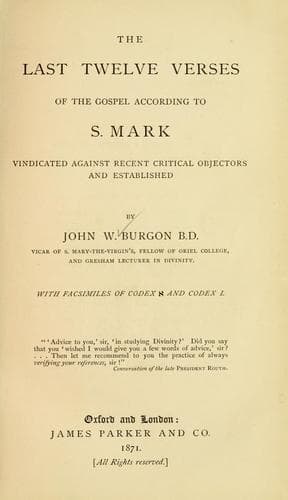
The Last Twelve Verses of the Gospel According to S. MarkBurgon, John William
Religion
The Last Twelve Verses of the Gospel According to S. Mark
Burgon, John William
Bible. Mark XVI, 9-20 -- Criticism, Textual
(_c_) On the other hand, supposing that S. Paul actually did address to
different Churches copies of the present Epistle, and was scrupulous (as
of course he was) to fill in the addresses himself before the precious
documents left his hands,—then, doubtless, each several Church would have
received, cherished, and jealously guarded its own copy. But if _this_ had
been the case, (or indeed if Tychicus had filled up the blanks for the
Apostle,) is it not simply incredible that we should never have heard a
word about the matter until now? unaccountable, above all, that there
should nowhere exist traces of _conflicting testimony_ as to the Church to
which S. Paul’s Epistle to the Ephesians was addressed? whereas _all_ the
most ancient writers, without exception,—(Marcion himself [A.D. 140(177)],
the “Muratorian” fragment [A.D. 170 or earlier], Irenæus [A.D. 175],
Clemens Alexandrinus, Tertullian, Origen, Dionysius Alexandrinus, Cyprian,
Eusebius,)—and all copies wheresoever found, give one unvarying,
unfaltering witness. Even in Cod. B. and Cod. א, (and this is much to be
noted,) the _superscription_ of the Epistle attests that it was addressed
“to the Ephesians.” Can we be warranted (I would respectfully inquire) in
inventing facts in the history of an Apostle’s practice, in order to
account for what seems to be after all only an ordinary depravation of his
text?(178)
(3) But, in fact, it is high time to point out that such “_a Circular_” as
was described above, (each copy furnished with a blank, to be filled up
with the name of a different City,) would be a document without parallel
in the annals of the primitive Church. It is, as far as I am aware,
essentially a modern notion. I suspect, in short, that the suggestion
before us is only another instance of the fatal misapprehension which
results from the incautious transfer of the notions suggested by some
familiar word in a living language to its supposed equivalent in an
ancient tongue. Thus, because κύκλιος or ἐγκύκλιος confessedly signifies
“circularis,” it seems to be imagined that ἐγκύκλιος ἐπιστολή may mean “a
Circular Letter.” Whereas it really means nothing of the sort; but—“_a
Catholic Epistle_.”(179)
Public-domain text, read in full here on John Shaqi.
Reviews
Reviews
No reviews yet
Be the first to share your thoughts on this work.
Elsewhere in the archive
Join the Discussion
Join the discussion
Sign in to leave a comment or review.
Sign InorCreate an account