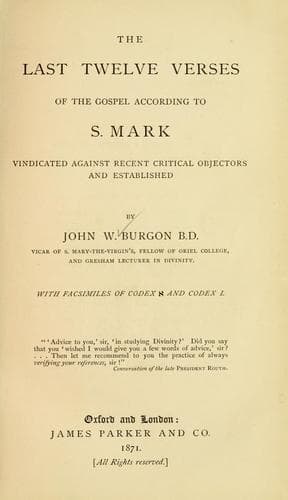
The Last Twelve Verses of the Gospel According to S. MarkBurgon, John William
Religion
The Last Twelve Verses of the Gospel According to S. Mark
Burgon, John William
Bible. Mark XVI, 9-20 -- Criticism, Textual
An “_Encyclical_” (and _that_ is the word which has been imported into the
present discussion), was quite a different document from what _we_ call “a
Circular.” Addressed to no one Church or person in particular, it was
Catholic or General,—the common property of all to whom it came. The
General (or Catholic) Epistles of S. James, S. Peter, S. John are
“Encyclical.”(180) So is the well-known Canonical Epistle which Gregory,
Bp. of Neocæsaræa in Pontus, in the middle of the third century, sent to
the Bishops of his province.(181) As for “_a blank circular_” to be filled
up with the words “in Ephesus,” “in Laodicea,” &c.,—its like (I repeat) is
wholly unknown in the annals of Ecclesiastical Antiquity. The two notions
are at all events inconsistent and incompatible. If S. Paul’s Epistle to
the Ephesians was “a Circular,” then it was not “Encyclical:” if it was
“Encyclical” then it was not “a Circular.”
Are we then deliberately to believe, (for to this necessity we are
logically reduced,) that the Epistle which occupies the fifth place among
S. Paul’s writings, and which from the beginning of the second
century,—that is, from the very dawn of Historical evidence,—has been
known as “the Epistle to the Ephesians,” was an “Encyclical,” “Catholic”
or “General Epistle,”—addressed τοῖς ἀγίοις τοῖς οὔσι, καὶ πιστοῖς ἐν
Χριστῷ Ἰησοῦ? There does not live the man who will accept so irrational a
supposition. The suggestion therefore by which it has been proposed to
account for the absence of the words ἐν Ἐφέσῳ in Ephes. i. 1 is not only
in itself in the highest degree improbable, and contradicted by all the
evidence to which we have access; but it is even inadmissible on critical
grounds, and must be unconditionally surrendered.(182) It is observed to
collapse before every test which can be applied to it.
III. Altogether marvellous in the meantime it is to me,—if men must needs
account for the omission of the words ἐν Ἐφέσῳ from this place,—that they
should have recourse to wild, improbable, and wholly unsupported theories,
like those which go before; while an easy,—I was going to say the
obvious,—solution of the problem is close at hand, and even solicits
acceptance.
Marcion the heretic, (A.D. 140) is distinctly charged by Tertullian (A.D.
200), and by Jerome a century and a half later, with having abundantly
mutilated the text of Scripture, and of S. Paul’s Epistles in particular.
Epiphanius compares the writing which Marcion tampered with to a
moth-eaten coat.(183) “Instead of a stylus,” (says Tertullian,) “Marcion
employed a knife.” “What wonder if he omits syllables, since often he
omits whole pages?”(184) S. Paul’s Epistle to the Ephesians, Tertullian
even singles out by name; accusing Marcion of having furnished it with a
new title. All this has been fully explained above, from page 93 to page
96.
Public-domain text, read in full here on John Shaqi.
Reviews
Reviews
No reviews yet
Be the first to share your thoughts on this work.
Elsewhere in the archive
Join the Discussion
Join the discussion
Sign in to leave a comment or review.
Sign InorCreate an account