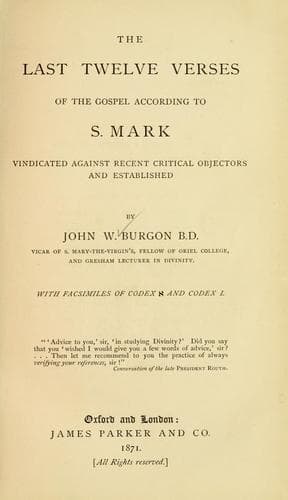
The Last Twelve Verses of the Gospel According to S. MarkBurgon, John William
Religion
The Last Twelve Verses of the Gospel According to S. Mark
Burgon, John William
Bible. Mark XVI, 9-20 -- Criticism, Textual
But however all this may be, (as already pointed out,) the only question
to be determined by us is,—whether it be credible that the words ἐν Ἐφέσῳ
are an unauthorized addition; foisted into the text of Ephes. i. 1 as far
back as the Apostolic age: an interpolation which, instead of dying out,
and at last all but disappearing, has spread and established itself, until
the words are found in every copy,—are represented in every
translation,—have been recognised in every country,—witnessed to by every
Father,—received in every age of the Church? I repeat that the one
question which has to be decided is, not _how_ the words ἐν Ἐφέσῳ came to
be put in, or came to be left out; but simply whether, on an impartial
review of the evidence, it be reasonable (with Tischendorf, Tregelles,
Conybeare and Howson, and so many more,) to suspect their genuineness and
enclose them in brackets? Is it _credible_ that the words ἐν Ἐφέσῳ are a
spurious and unauthorized addition to the inspired autograph of the
Apostle?... We have already, as I think, obtained a satisfactory answer to
this question. It has been shewn, as conclusively as in inquiries of this
nature is possible, that in respect of the reading of Ephesians i. 1,
Codd. B and א are even _most_ conspicuously at fault.
IV. But if these two Codices are thus convicted of error in respect of the
one remaining text which their chief upholders have selected, and to which
they still make their most confident appeal,—what remains, but to point
out that it is high time that men should be invited to disabuse their
minds of the extravagant opinion which they have been so industriously
taught to entertain of the value of the two Codices in question? It has
already degenerated into an unreasoning prejudice, and threatens at last
to add one more to the already overgrown catalogue of “vulgar errors.”
V. I cannot, I suppose, act more fairly by Tischendorf than by
transcribing in conclusion his remarks on the four remaining readings of
Codex א to which he triumphantly appeals: promising to dismiss them all
with a single remark. He says, (addressing unlearned readers,) in his
“Introduction” to the Tauchnitz (English) New Testament(187):—
Public-domain text, read in full here on John Shaqi.
Reviews
Reviews
No reviews yet
Be the first to share your thoughts on this work.
Elsewhere in the archive
Join the Discussion
Join the discussion
Sign in to leave a comment or review.
Sign InorCreate an account