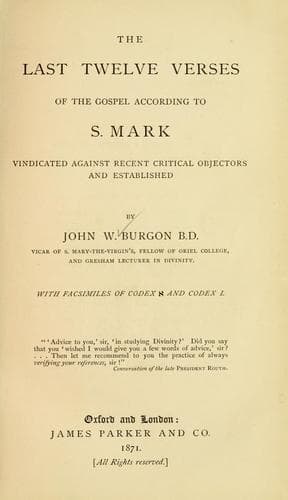
The Last Twelve Verses of the Gospel According to S. MarkBurgon, John William
Religion
The Last Twelve Verses of the Gospel According to S. Mark
Burgon, John William
Bible. Mark XVI, 9-20 -- Criticism, Textual
I do not lose sight of the fact that the Epistle to the Ephesians ends
without salutations, without personal notices of any kind. But in this
respect it is not peculiar.(186) _That_,—joined to a singular absence of
identifying allusion,—sufficiently explains why Marcion selected this
particular Epistle for the subject of his fraud. But, to infer from this
circumstance, in defiance of the Tradition of the Church Universal, and in
defiance of its very Title, that the Epistle is “Encyclical,” in the
technical sense of that word; and to go on to urge this characteristic as
an argument in support of the omission of the words ἐν Ἐφέσῳ,—is clearly
the device of an eager Advocate; not the method of a calm and unprejudiced
Judge. True it is that S. Paul,—who, writing to the Corinthians from
Ephesus, says “_the Churches of Asia_ salute you,” (1 Cor. xvi. 19,)—may
have known very well that an Epistle of his “to the Ephesians,” would, as
a matter of course, be instantly communicated to others besides the
members of that particular Church: and in fact this may explain why there
is nothing specially “Ephesian” in the contents of the Epistle. The
Apostle,—(as when he addressed “the Churches of Galatia,”)—may have had
certain of the other neighbouring Churches in his mind while he wrote. But
all this is wholly foreign to the question before us: the one _only_
question being _this_,—Which of the three following addresses represents
what S. Paul must be considered to have actually written in the first
verse of his “Epistle to the Ephesians”?—
(1) τοῖς ἀγίοις τοῖς οὔσιν ἐν Ἐφέσῳ καὶ πιστοῖς ἐν Χ. Ἰ.
(2) τοῖς ἀγίοις τοῖς οὔσιν ἐν ... καὶ πιστοῖς ἐν Χ. Ἰ.
(3) τοῖς ἀγίοις τοῖς οὔσι, καὶ πιστοῖς ἐν Χ. Ἰ.
What I have been saying amounts to this: that it is absolutely
unreasonable for men to go out of their way to invent a theory wanting
every element of probability in order to account for the omission of the
words ἐν Ἐφέσῳ from S. Paul’s Epistle to the Ephesians; while they have
under their eyes the express testimony of a competent witness of the iind
century that a certain heretic, named Marcion, “presumed to prefix an
unauthorized title to that very Epistle,” (“Marcion ei titulum aliquando
interpolare gestiit,”)—which title obviously _could not stand unless those
two words were first erased from the text_. To interpolate that new title,
and to erase the two words which were plainly inconsistent with it, were
obviously correlative acts which must always have been performed together.
Public-domain text, read in full here on John Shaqi.
Reviews
Reviews
No reviews yet
Be the first to share your thoughts on this work.
Elsewhere in the archive
Join the Discussion
Join the discussion
Sign in to leave a comment or review.
Sign InorCreate an account