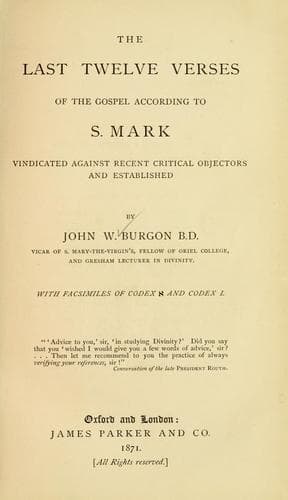
The Last Twelve Verses of the Gospel According to S. MarkBurgon, John William
Religion
The Last Twelve Verses of the Gospel According to S. Mark
Burgon, John William
Bible. Mark XVI, 9-20 -- Criticism, Textual
It cannot be needful that I should delay the reader with any remarks on
such a termination of the Gospel as the foregoing. It was evidently the
production of some one who desired to remedy the conspicuous
incompleteness of his own copy of S. Mark’s Gospel, but who had imbibed so
little of the spirit of the Evangelical narrative that he could not in the
least imitate the Evangelist’s manner. As for the scribe who executed
Codex L, he was evidently incapable of distinguishing the grossest
fabrication from the genuine text. The same worthless supplement is found
in the margin of the Hharklensian Syriac (A.D. 616), and in a few other
quarters of less importance.(218)—I pass on, with the single remark that I
am utterly at a loss to understand on what principle Cod. L,—a solitary
MS. of the viiith or ixth century which exhibits an exceedingly vicious
text,—is to be thought entitled to so much respectful attention on the
present occasion, rebuked as it is for the fallacious evidence it bears
concerning the last twelve verses of the second Gospel by all the
seventeen remaining Uncials, (three of which are from 300 to 400 years
more ancient than itself;) and by _every cursive copy of the Gospels in
existence_. Quite certain at least is it that not the faintest additional
probability is established by Cod. L that S. Mark’s Gospel when it left
the hands of its inspired Author was in a mutilated condition. The copyist
shews that he was as well acquainted as his neighbours with our actual
concluding Verses: while he betrays his own incapacity, by seeming to view
with equal favour the worthless alternative which he deliberately
transcribes as well, and to which he gives the foremost place. _Not_ S.
Mark’s Gospel, _but Codex L_ is the sufferer by this appeal.
III. I go back now to the statements found in certain Codices of the xth
century, (derived probably from one of older date,) to the effect that
“the marginal references to the Eusebian Canons extend no further than
ver. 8:”—for so, I presume, may be paraphrased the words, (see p. 120,)
ἕως οὖ Εὐσέβιους ὁ Παμφίλου ἐκανόνισεν, which are found at the end of ver.
8 in Codd. 1, 206, 209.
(1.) Now this statement need not have delayed us for many minutes. But
then, therewith, recent Critics have seen fit to connect another and an
entirely distinct proposition: viz. that
AMMONIUS
Public-domain text, read in full here on John Shaqi.
Reviews
Reviews
No reviews yet
Be the first to share your thoughts on this work.
Elsewhere in the archive
Join the Discussion
Join the discussion
Sign in to leave a comment or review.
Sign InorCreate an account